
Mavorixafor trihydrochloride
A CXC chemokine receptor 4 antagonist used to treat WHIM syndrome.
概况
Mavorixafor is a CXC chemokine receptor 4 (CXCR4) antagonist. It was first approved by the FDA on April 30, 2024, for the treatment of warts, hypogammaglobulinemia, infections, and myelokathexis (WHIM) syndrome, a genetic immunodeficiency disorder characterized by a reduced number of mature neutrophils and lymphocytes. WHIM syndrome is caused by mutations in the CXCR4 gene, which leads to overactivation of CXCR4 signalling pathways. Mavorixafor prevents the activation of CXCR4.
Synonyms: CXCR4 INHIBITOR X4P-001; 1,4-BUTANEDIAMINE, N-(1H-BENZIMIDAZOL-2-YLMETHYL)-N-((8S)-5,6,7,8-TETRAHYDRO-8-QUINOLINYL)-; 1,4-BUTANEDIAMINE, N1-(1H-BENZIMIDAZOL-2-YLMETHYL)-N1-((8S)-5,6,7,8-TETRAHYDRO-8-QUINOLINYL)-; N1-(1H-BENZIMIDAZOL-2-YLMETHYL)-N1-((S)-5,6,7,8-TETRAHYDROQUINOLIN-8-YL)-BUTANE-1,4-DIAMINE
Product Categories: Amino Acid Derivatives; Peptide; Pharmaceutical Active Pharmaceutical Ingredient (API); Peptide Intermediate; Protein/Peptide; Active Pharmaceutical Ingredient (API); Protected Amino Acid; Polypeptide Active Pharmaceutical Ingredient
Mol File: 2309699-17-8.mol
物化性质
Melting Point: >180°C (dec.)
Specific Rotation: [α]₂₃ᴰ -58.8° (c=0.33 in acetic acid)
Density: 1.52±0.1 g/cm³
Storage Condition: -20°C
Solubility: Soluble in aqueous media (slightly), methanol (very slightly, heated, sonicated)
pKa (Acid Dissociation Constant): 9.82±0.15
Form: Powder
Color: White to Off-White
Stability: Hygroscopic
MSDS信息
实验数据
1. Cell experiment
Solubility in DMSO: 150 mg/mL (326.90 mM; ultrasonic assistance required; hygroscopic DMSO significantly affects the solubility of the product, please use newly opened DMSO)
Preparing Stock Solutions:
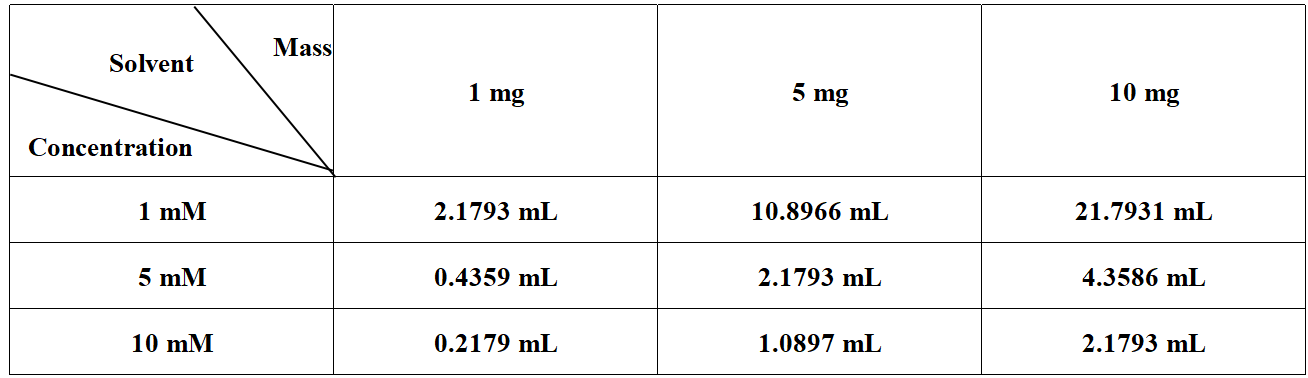
Solubility in H2O: 100 mg/mL (217.93 mM; ultrasonic assistance required)
Please select an appropriate solvent to prepare the stock solution based on the solubility of the product in different solvents. Once prepared, aliquot and store to avoid product failure caused by repeated freeze-thaw cycles.
Storage method and duration of stock solution: -80°C, 6 months; -20°C, 1 month (sealed storage, away from moisture). When stored at -80°C, use within 6 months; when stored at -20°C, use within 1 month.
Note: If you choose water as the solvent for the stock solution, please dilute it to the working solution concentration and then filter and sterilize using a 0.22 μm filter before use.
2. Animal experiment
Please select an appropriate dissolution scheme based on your experimental animals and route of administration.
The following dissolution schemes all require first preparing a clear stock solution according to the In Vitro method, followed by sequential addition of co-solvents:
—To ensure the reliability of experimental results, the clear stock solution can be stored appropriately according to storage conditions; for in vivo working solutions, it is recommended to prepare them fresh and use on the same day.
The percentage displayed before each solvent indicates the volume ratio of that solvent in the final solution you prepare; if precipitation or crystallization occurs during preparation, it can be resolved by heating and/or ultrasonication.
Scheme 1
Please add each solvent in sequence: 5% DMSO, 40% PEG300, 5% Tween-80, 50% Saline
Solubility: ≥ 2.62 mg/mL (5.71 mM); clear solution
Scheme 2
Please add each solvent in sequence: 5% DMSO, 95% (20% SBE-β-CD in Saline)
Solubility: ≥ 2.62 mg/mL (5.71 mM); clear solution
Scheme 3
Please add each solvent in sequence: 10% DMSO, 40% PEG300, 5% Tween-80, 45% Saline
Solubility: ≥ 0.6 mg/mL (1.31 mM); clear solution
This scheme yields a clear solution of ≥ 0.6 mg/mL (saturation unknown).
Taking 1 mL of working solution as an example: add 100 μL of 6.0 mg/mL clear DMSO stock solution to 400 μL of PEG300 and mix well; then add 50 μL of Tween-80 to the above system and mix well; then continue adding 450 μL of normal saline to bring the volume to 1 mL.
Preparation of normal saline: dissolve 0.9 g of sodium chloride in ddH₂O and bring to a volume of 100 mL to obtain a clear and transparent normal saline solution.
Scheme 4
Please add each solvent in sequence: 10% DMSO, 90% (20% SBE-β-CD in Saline)
Solubility: ≥ 0.6 mg/mL (1.31 mM); clear solution
This scheme yields a clear solution of ≥ 0.6 mg/mL (saturation unknown).
Taking 1 mL of working solution as an example: add 100 μL of 6.0 mg/mL clear DMSO stock solution to 900 μL of 20% SBE-β-CD in saline and mix well.
Dissolve 2 g of SBE-β-CD (sulfobutylether β-cyclodextrin) powder in normal saline to a volume of 10 mL, and dissolve completely until clear and transparent.
Scheme 5
Please add each solvent in sequence: 10% DMSO, 90% Corn Oil
Solubility: ≥ 0.6 mg/mL (1.31 mM); clear solution
This scheme yields a clear solution of ≥ 0.6 mg/mL (saturation unknown). Use this scheme judiciously for animal experiments lasting over half a month.
Taking 1 mL of working solution as an example: add 100 μL of 6.0 mg/mL clear DMSO stock solution to 900 μL of corn oil and mix well.
For the following dissolution schemes, please prepare the working solution directly. It is recommended to prepare fresh and use as soon as possible within a short period. The percentage displayed before each solvent indicates the volume ratio of that solvent in the final solution you prepare; if precipitation or crystallization occurs during preparation, it can be resolved by heating and/or ultrasonication.
Scheme 1
Please add each solvent in sequence: PBS
Solubility: 100 mg/mL (217.93 mM); clear solution; ultrasonic assistance required
Pharmacodynamics
Mavorixafor works to reduce the symptoms of WHIM syndrome, such as infections and warts, by increasing the mobilization and trafficking of white blood cells from the bone marrow.Mavorixafor dose-dependently increases absolute neutrophil count and absolute lymphocyte count.
In healthy volunteers, mavorixafor was shown to prolong the QT interval in a concentration-dependent manner
Mechanism Of Action
WHIM syndrome is a rare primary immunodeficiency disorder predominantly linked to heterozygous gain-of-function mutations in the C-terminus of the C-X-C chemokine receptor 4 (CXCR4), which is a chemokine receptor that regulates immune cell trafficking and homeostasis.CXCR4 is a G protein-coupled receptor (GPCR) that activates downstream pathways such as G-protein signalling, calcium mobiliation, and ERK/AKT activation.3CXC Chemokine Ligand 12 (CXCL12), previously known as stromal-derived factor-1α (SDF-1α), is a sole ligand of CXCR4 2 that binds to the receptor and promotes the trafficking and homing of leukocytes to and from the bone marrow compartment.Gain-of-function mutations in the CXCR4 receptor gene result in desensitization defects and increased responsiveness to CXCL12, overactivation of CXCR4 downstream pathways, and the retention of leukocytes in the bone marrow.Due to a reduced number of mature neutrophils and lymphocytes, patients with WHIM syndrome experience a variety of manifestations of the disorder, including panleukopenia and an increased susceptibility to infections and malignancy. Mavorixafor is an orally bioavailable CXCR4 antagonist that blocks the binding of CXCL12 to CXCR4. Mavorixafor inhibits the response to CXCL12 in both wild-type and mutated CXCR4 variants associated with WHIM syndrome.Treatment with mavorixafor results in increased mobilization of neutrophils and lymphocytes from the bone marrow into the peripheral circulation.
相似产品
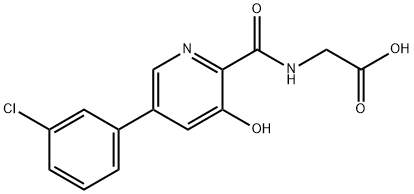
Vadadustat
治疗领域
: Cardiometabolic diseases
作用靶点
: HIF-PHs
CAS
: 1000025-07-9
分子式
: C14H11ClN2O4
分子量
: 306.7
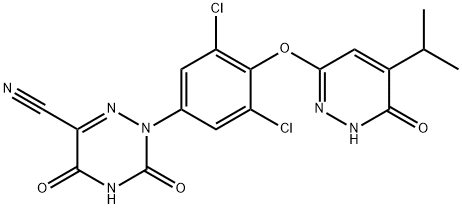
Resmetirom
治疗领域
: Cardiometabolic diseases
作用靶点
: THRB
CAS
: 920509-32-6
分子式
: C17H12Cl2N6O4
分子量
: 435.22
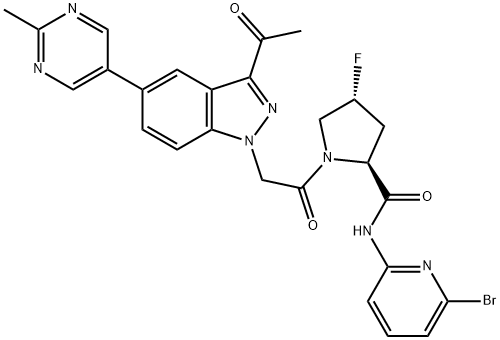
Danicopan
治疗领域
: Cardiometabolic diseases
作用靶点
: CFD
CAS
: 1903768-17-1
分子式
: C26H23BrFN7O3
分子量
: 580.41
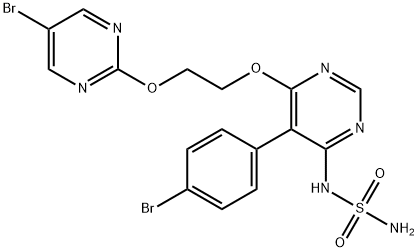
Aprocitentan
治疗领域
: Cardiometabolic diseases
作用靶点
: ETAR; ETBR
CAS
: 1103522-45-7
分子式
: C16H14Br2N6O4S
分子量
: 546.19