
Vepdegestrant
A proteolysis-targeting chimera (PROTAC) estrogen receptor (ER) degrader; being developed for the treatment of ER-positive, HER2-negative locally advanced or metastatic breast cancer.
Overview
Vepdegestrant (ARV-471) is an orally active PROTAC protein degrader of the estrogen receptor for the treatment of breast cancer. It is a heterobifunctional molecule that facilitates the interaction between estrogen receptor alpha and intracellular E3 ligase complexes.
Synonyms: ARV-471; PF-07850327
Product Categories: inhibitor; t2z001
Mol File: 2229711-68-4.mol
Physicochemical Properties
Storage temp: -20°C, sealed storage, away from moisture and light
Solubility: DMSO: 110 mg/mL (151.95 mM; Need ultrasonic)
Form: Solid
Color: White to Off-White
MSDS Information
Experimental Data
1. Cell Experiment
DMSO: 100 mg/mL (138.14 mM; Ultrasonic required)
Preparing Stock Solutions:
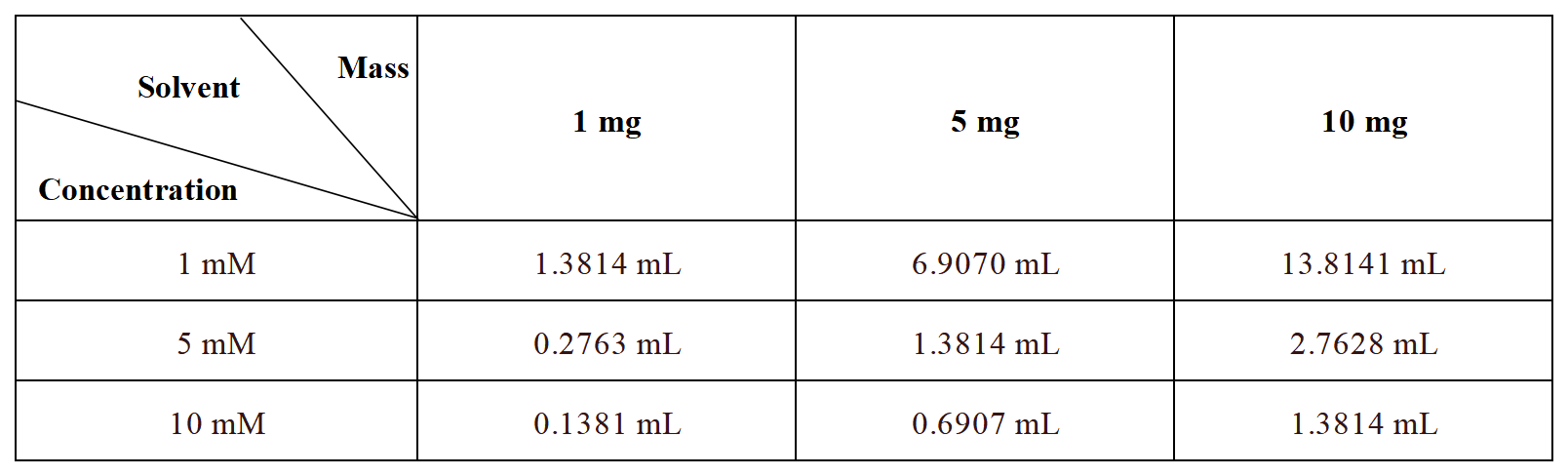
Please prepare the stock solution in the appropriate solvent based on the product's solubility in different solvents. Once dissolved, aliquot the solution to avoid product inactivation caused by repeated freeze-thaw cycles.
Storage method and shelf life of the stock solution: -80°C, 2 years; -20°C, 1 year (sealed storage, away from moisture and light). When stored at -80°C, please use within 2 years; when stored at -20°C, please use within 1 year.
2. Animal Experiment
Please select the appropriate dissolution protocol based on your experimental animals and administration method. For the following protocols, first prepare a clear stock solution in vitro, then add co-solvents in sequence:
To ensure reliable experimental results, the clear stock solution can be stored appropriately according to the storage conditions. For in vivo experiments, it is recommended to prepare the working solution fresh and use it on the same day.
The percentages shown before the solvents refer to the volume percentage of each solvent in the final solution. If precipitation occurs during preparation, heating and/or sonication can be used to aid dissolution.
Protocol 1
Add each solvent in the following order: 10% DMSO, 90% Corn Oil
Solubility: ≥ 5.5 mg/mL (7.60 mM); Clear solution
This protocol yields a clear solution with a concentration of ≥ 5.5 mg/mL (saturation unknown). This protocol is not suitable for experiments lasting longer than half a month.
Preparation example for a 1 mL working solution:
Take 100 μL of the 55.0 mg/mL clear DMSO stock solution and add it to 900 μL of corn oil, mix well.
Protocol 2
Add each solvent in the following order: 10% DMSO, 40% PEG300, 5% Tween-80, 45% Saline
Solubility: ≥ 2 mg/mL (2.76 mM); Clear solution
This protocol yields a clear solution with a concentration of ≥ 2 mg/mL (2.76 mM, saturation unknown).
Preparation example for a 1 mL working solution:
Take 100 μL of the 20.0 mg/mL clear DMSO stock solution and add it to 400 μL of PEG300, mix well. Then add 50 μL of Tween-80 to the mixture and mix thoroughly. Finally, add 450 μL of normal saline to bring the volume to 1 mL.
Protocol 3
Add each solvent in the following order: 10% DMSO, 90% (20% SBE-β-CD in Saline)
Solubility: 2 mg/mL (2.76 mM); Suspended solution; Ultrasonic required
This protocol yields a homogeneous suspension at 2 mg/mL (2.76 mM), suitable for oral and intraperitoneal administration.
Preparation example for a 1 mL working solution:
Take 100 μL of the 20.0 mg/mL clear DMSO stock solution and add it to 900 μL of a 20% SBE-β-CD solution in saline, mix well.
Pharmacodynamics
Mechanism Of Action
Similar Products

Toremifene Citrate
Therapy
: Oncology
Target
: ERs
CAS
: 89778-27-8
MF
: C26H28ClNO.C6H8O7
MW
: 598.08
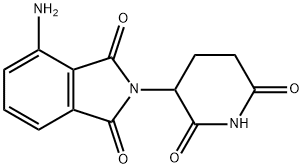
Pomalidomide
Therapy
: Oncology
Target
: TNFα;IKZF1;IKZF3;IL6
CAS
: 19171-19-8
MF
: C13H11N3O4
MW
: 273.24
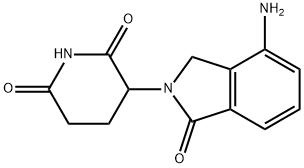
Lenalidomide
Therapy
: Oncology
Target
: CSNK1A1;IKZF1;IKZF3;CRBN
CAS
: 191732-72-6
MF
: C13H13N3O3
MW
: 259.261
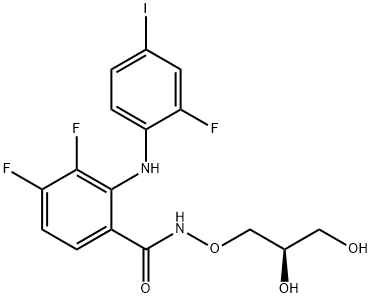
Mirdametinib
Therapy
: Oncology
Target
: MEK2; MEK1
CAS
: 391210-10-9
MF
: C16H14F3IN2O4
MW
: 482.19