
Tovorafenib
A type II RAF inhibitor, a kinase inhibitor. It is indicated for the treatment of pediatric low-grade glioma with BRAF genetic alterations.
概况
Tovorafenib is a selective type II RAF kinase inhibitor with antitumor activity. It specifically inhibits BRAF oncogenic mutations and blocks the aberrant activation of the MAPK signaling pathway, providing a targeted therapeutic option for pediatric patients with low-grade glioma harboring BRAF genetic alterations.
Synonyms: CS-2188; TAK-580(MLN-2480); MLN2480; MLN2480(BIIB-024); TAK-580; AMG-2112819; DAY-101; BSK-1369; 2-[(1r)-1-[(6-amino-5-chloropyrimidine-4-carbonyl)amino]ethyl]-n-[5-chloro-4-(trifluoromethyl)pyridin-2-yl]-1,3-thiazole-5-carboxamide; BIIB-024; MLN2480; MLN-2480; (R)-2-(1-(6-amino-5-chloropyrimidine-4-carboxamiChemicalbookdo)ethyl)-N-(5-chloro-4-(trifluoromethyl)pyridin-2-yl)thiazole-5-carboxamide; 6-Amino-5-chloro-N-[(1R)-1-[5-[[[5-chloro-4-(trifluoromethyl)-2-pyridinyl]amino]carbonyl]-2-thiazolyl]ethyl]-4-pyrimidinecarboxamide
Product Categories: B-Raf serine-threonine kinase (BRAF) inhibitors; BCRP/ABCG2 Inhibitors; Cytochrome P-450 CYP2B6 Inducers; Cytochrome P-450 CYP2C9 Substrates; Cytochrome P-450 Enzyme Inducers; Cytochrome P-450 Enzyme Inhibitors; Heterocyclic Compounds, Fused-Ring; Kinase Inhibitor; Sulfur Compounds
Mol File: 1096708-71-2.mol
物化性质
Melting point: 197-199°C
Boiling point: 585.3±50.0°C
Storage temp: Hygroscopic, Refrigerator, under inert atmosphere
Solubility: DMSO (Slightly), Methanol (Slightly)
Form: Solid
Color: White
MSDS信息
实验数据
1. Cell Experiment
DMSO : 100 mg/mL (197.52 mM; Need ultrasonic)
Preparing Stock Solutions:
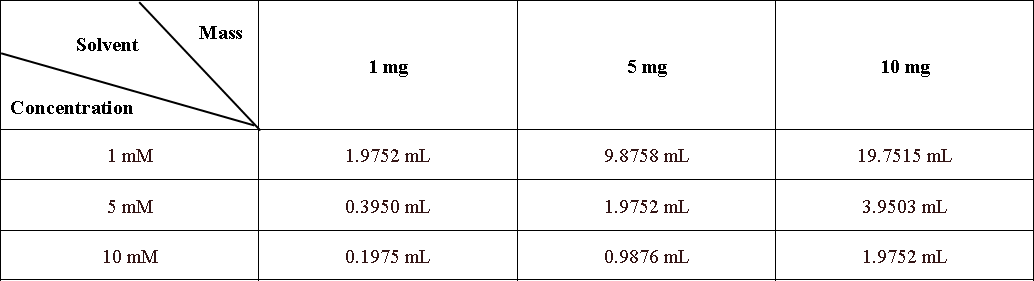
Please select an appropriate solvent for preparing stock solutions based on the product's solubility in different solvents. Once prepared, aliquot and store the solution to avoid product degradation caused by repeated freeze-thaw cycles. Storage conditions and shelf life for stock solutions: -80°C, 2 years; -20°C, 1 year. When stored at -80°C, use within 2 years; when stored at -20°C, use within 1 year.
2. Animal Experiment
Please select an appropriate dissolution protocol based on your experimental animals and route of administration. For the following protocols, first prepare a clear stock solution following the in vitro method, then add cosolvents sequentially:
To ensure experimental reliability, the clear stock solution can be appropriately stored according to storage conditions. For in vivo working solutions, it is recommended to prepare them fresh and use on the same day. The percentage indicated before each solvent represents its volume ratio in the final solution. If precipitation occurs during preparation, heating and/or ultrasonication can be used to aid dissolution.
Protocol 1
Add solvents in order: 10% DMSO → 40% PEG300 → 5% Tween-80 → 45% saline
Solubility: ≥ 0.67 mg/mL (1.32 mM); Clear solution
This protocol yields a clear solution of ≥ 0.67 mg/mL (1.32 mM, saturation unknown).
Example for 1 mL working solution: Add 100 μL of 6.7 mg/mL clear DMSO stock solution to 400 μL PEG300 and mix well. Add 50 μL Tween-80 to the mixture and mix thoroughly. Then add 450 μL saline to bring the volume to 1 mL.
Protocol 2
Add solvents in order: 10% DMSO → 90% (20% SBE-β-CD in saline)
Solubility: ≥ 0.67 mg/mL (1.32 mM); Clear solution
This protocol yields a clear solution of ≥ 0.67 mg/mL (1.32 mM, saturation unknown).
Example for 1 mL working solution: Add 100 μL of 6.7 mg/mL clear DMSO stock solution to 900 μL of 20% SBE-β-CD in saline and mix well.
Protocol 3
Add solvents in order: 10% DMSO → 90% corn oil
Solubility: ≥ 0.67 mg/mL (1.32 mM); Clear solution
This protocol yields a clear solution of ≥ 0.67 mg/mL (1.32 mM, saturation unknown). This method is not suitable for experiments lasting longer than half a month.
Example for 1 mL working solution: Add 100 μL of 6.7 mg/mL clear DMSO stock solution to 900 μL corn oil and mix well.
Pharmacodynamics
Tovorafenib is an anticancer agent with antitumour activity. Exposure to tovorafenib is associated with a reduction in height-for-age z-scores in pediatric patients. Reduced height-for-age risk persists during treatment with tovorafenib. Higher drug exposure is associated with an increased risk of skin rash, elevated liver enzymes (AST and ALT), and elevated creatinine phosphokinase.
Mechanism Of Action
Pediatric low-grade glioma, the most common childhood central nervous system (CNS) tumour, is often associated with BRAF genomic alterations, such as BRAF fusion or rearrangement. The BRAF kinase family is activated by RAS to phosphorylate MEK1/2, which phosphorylates ERK1/2 and promotes downstream signalling cascades that regulate multiple cellular processes, such as cell growth, proliferation, and differentiation. Oncogenic mutations in BRAF lead to an aberrant and hyperactivated RAS-RAF-MEK-ERK pathway, also known as the mitogen-activated protein kinase (MAPK) signalling pathway. Several RAF kinase inhibitors have been developed to treat cancers with BRAF mutations. These RAF inhibitors have been categorized into different "types" depending on their selectivity to a BRAF isoform and binding modes. Tovorafenib is a Type II RAF kinase inhibitor. RAF has a conserved three-residue segment (Asp-Phe-Gly) located at the N-terminus of the kinase activation loop called a DFG motif. In a state called a “DGF-out” conformation, the DFG motif is flipped in a way that reorients the phenylalanine residue, leaving a vacant site in which the drug can extend from the ATP site to insert a hydrophobic group. Tovorafenib is active against mutant BRAF V600E, wild-type BRAF, and wild-type CRAF kinases. Tovorafenib exhibited antitumor activity in cultured cells and xenograft tumour models harbouring BRAF V600E and V600D mutations, and in a xenograft model harbouring a BRAF fusion. Tovorafenib is not reported to induce paradoxical activation of the MAPK pathway.
相似产品
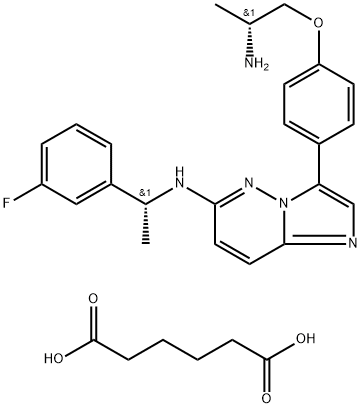
Taletrectinib
治疗领域
: Oncology
作用靶点
: ROS; Trk-A; Trk-B; Trk-C
CAS
: 1505515-69-4
分子式
: C29H34FN5O5
分子量
: 551.62
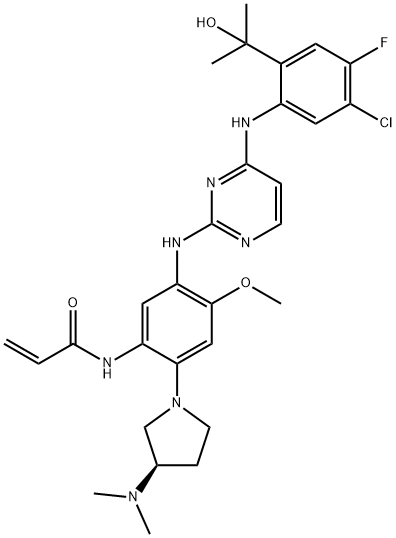
Sunvozertinib
治疗领域
: Oncology
作用靶点
: EGFR; HER2
CAS
: 2370013-12-8
分子式
: C29H35ClFN7O3
分子量
: 584.08
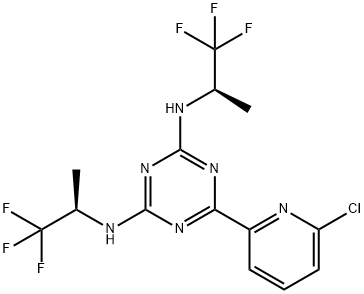
Vorasidenib
治疗领域
: Oncology
作用靶点
: IDH1; IDH2
CAS
: 1644545-52-7
分子式
: C14H13ClF6N6
分子量
: 414.74
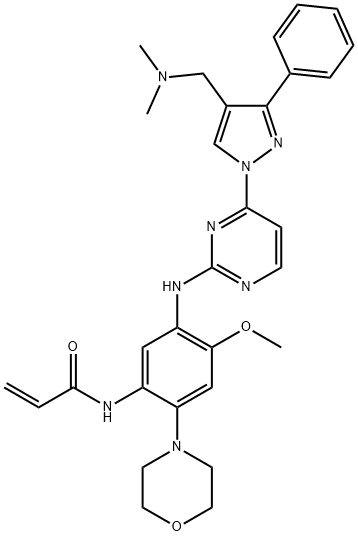
Lazertinib
治疗领域
: Oncology
作用靶点
: EGFR ; EGFR T790M ; EGFR L858R ; EGFR 19del
CAS
: 1903008-80-9
分子式
: C30H34N8O3
分子量
: 554.64