
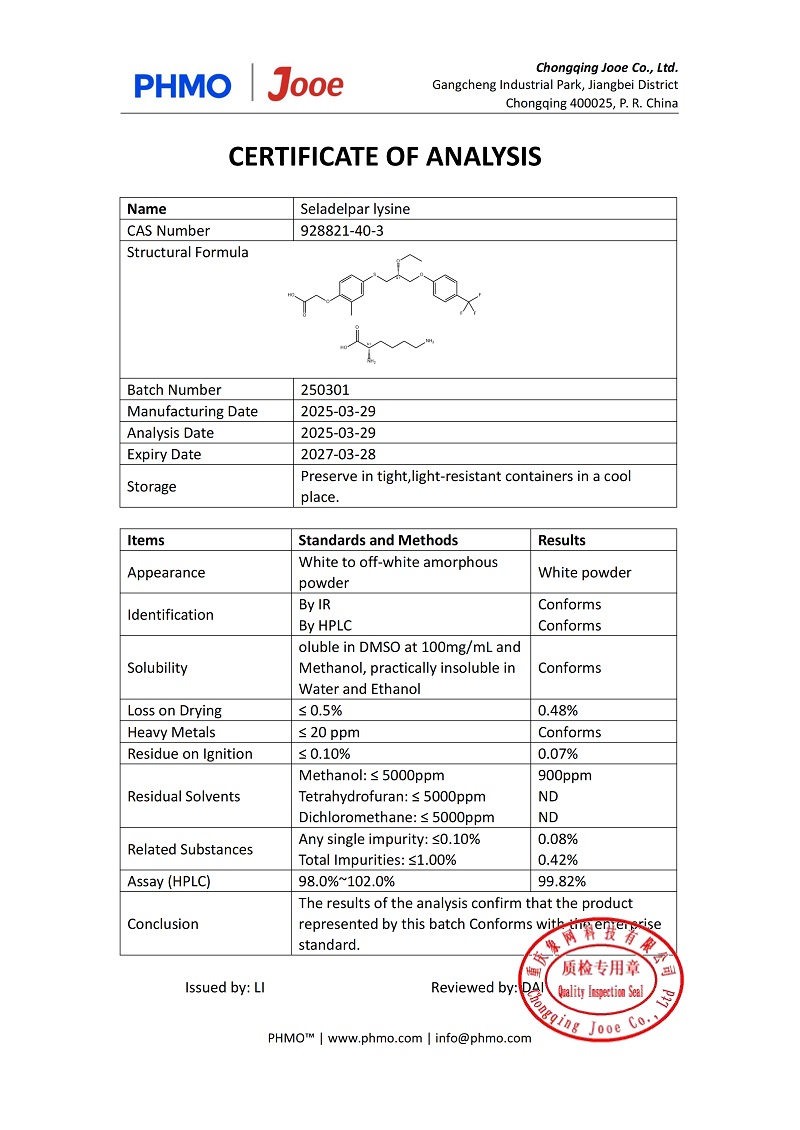
Seladelpar lysine
A peroxisome proliferator-activated receptor delta (PPARδ) agonist; being developed for the treatment of primary biliary cholangitis (PBC) and other cholestatic liver diseases.
概况
Seladelpar is a peroxisome proliferator-activated receptor (PPAR)-delta (δ) agonist. Seladelpar is a single enantiomer of the R-configuration. On August 14, 2024, seladelpar was granted accelerated approval by the FDA for the treatment of primary biliary cholangitis, which is a condition associated with aberrant bile acid metabolism. Seladelpar works to block bile acid synthesis.
Synonyms: MBX-8025; RWJ-800025; LIVDELZI; Seladelparum; Seladelpar
Product Categories: BCRP/ABCG2 Substrates; Cytochrome P-450 CYP2C8 Substrates; Fatty Acids, Volatile; Hypolipidemic Agents
Mol File: 928821-40-3.mol
物化性质
Storage temp: 4°C, sealed storage, away from moisture
Form: Solid
Color: White to Off-white
MSDS信息
实验数据
Pharmacodynamics
Seladelpar works to decrease the levels of total bile acids and reduce bile acid synthesis in patients with PBC. It is suggested that an increase in bile acid concentration in hepatobiliary disorders, including PBC, can lead to elevated alkaline phosphatase (ALP) levels. In patients with PBC treated with 10 mg once daily of seladelpar, a greater reduction in mean ALP from baseline was observed as early as one month after treatment compared to the placebo group and lower ALP was generally maintained through month 12. In another study in which patients with PBC were treated with 2, 5, or 10 mg once daily of seladelpar, a dose-dependent reduction in mean ALP was observed.
Mechanism Of Action
Peroxisome proliferator-activated receptors (PPARs) belong to the nuclear hormone receptor superfamily with three members - PPAR-alpha (α), PPAR-delta (δ), and PPAR-gamma (γ). Each PPAR plays a role in maintaining energy homeostasis and metabolic function, such as fatty acid metabolism, bile acid synthesis, and adipocyte differentiation. In chronic liver disorders such as PBC and nonalcoholic steatohepatitis (NASH), changes in bile acid composition and increased systemic bile acids are observed. Seladelpar is a PPAR-delta agonist; however, the mechanism by which seladelpar exerts its therapeutic effects in patients with PBC is not well understood. Pharmacological activity that is potentially relevant to therapeutic effects includes inhibition of bile acid synthesis through activation of PPARδ. Published studies show that PPARδ activation by seladelpar reduces bile acid synthesis through induction of Fibroblast Growth Factor 21 (FGF21) to activate the c-Jun N-terminal kinase (JNK) signalling pathway: This effect subsequently downregulates CYP7A1, the key enzyme for the synthesis of bile acids from cholesterol. It is suggested that the inhibitory effect of seladelpar on bile acid synthesis is independent of the farnesoid X receptor (FXR) pathway, another molecular pathway that regulates bile acid synthesis in the liver.
相似产品
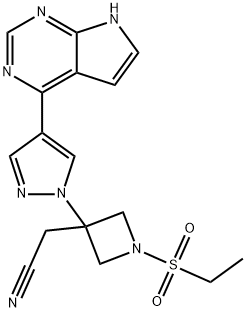
Baricitinib
治疗领域
: Immune-Inflammatory diseases
作用靶点
: JAK1;JAK2
CAS
: 1187594-09-7
分子式
: C16H17N7O2S
分子量
: 371.42
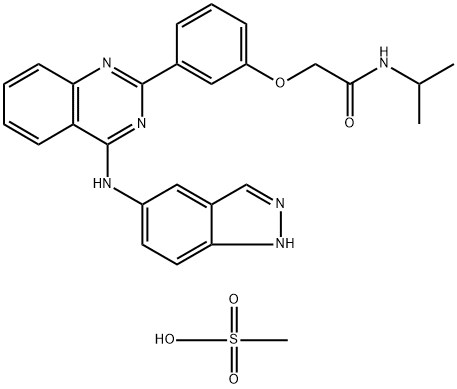
Belumosudil Mesylate
治疗领域
: Immune-Inflammatory diseases
作用靶点
: ROCK
CAS
: 2109704-99-4
分子式
: C27H28N6O5S
分子量
: 548.62
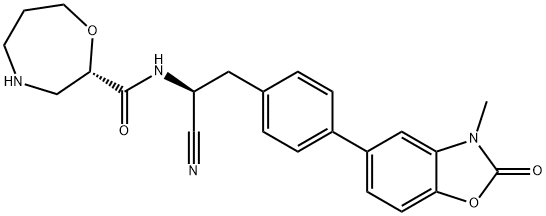
Brensocatib
治疗领域
: Immune-Inflammatory diseases
作用靶点
: CTSC
CAS
: 1802148-05-5
分子式
: C23H24N4O4
分子量
: 420.47
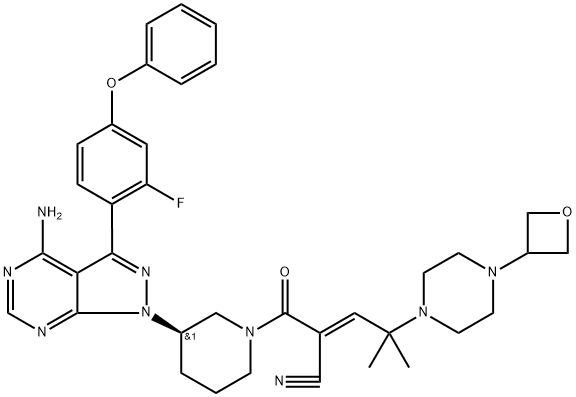
Rilzabrutinib
治疗领域
: Immune-Inflammatory diseases
作用靶点
: BTK
CAS
: 1575596-29-0
分子式
: C36H40FN9O3
分子量
: 665.77