
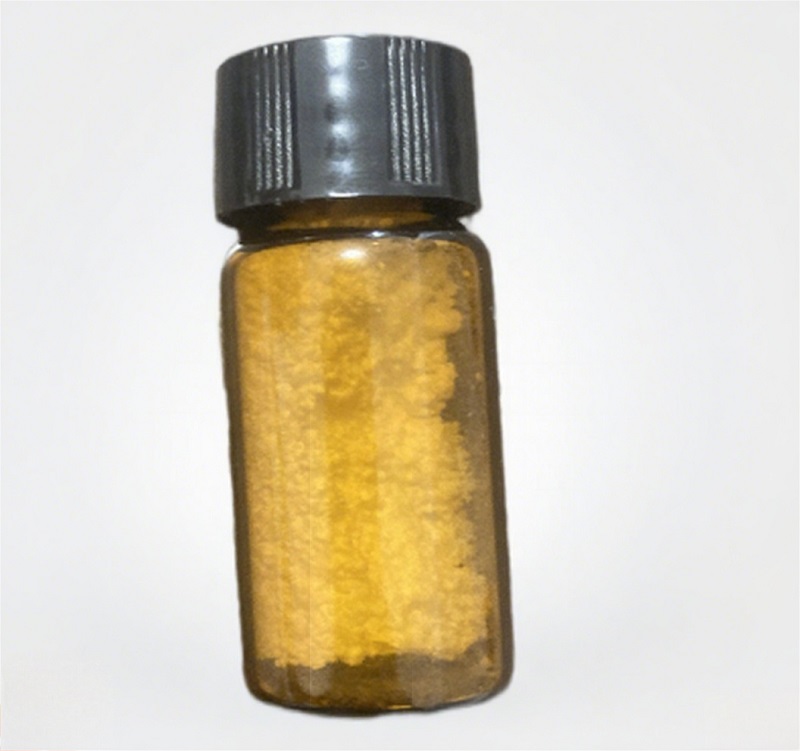
Rilzabrutinib
A reversible covalent, selective and oral active inhibitor of Bruton’s Tyrosine Kinase (BTK).
Overview
Rilzabrutinib is an effective oral small-molecule Bruton's Tyrosine Kinase (BTK) inhibitor with selective immunomodulatory effects. It can be used in the research of Immune Thrombocytopenia (ITP), pemphigus, and other B cell-mediated autoimmune diseases.
Synonyms: PRN-1008; SAR-444671; Wayrilz; Rilzabrutinb; (3R)-3-[4-Amino-3-(2-fluoro-4-phenoxyphenyl)-1H-pyrazolo[3,4-d]pyrimidin-1-yl]-?-[2-methyl-2-[4-(3-oxetanyl)-1-piperazinyl]propylidene]-?-oxo-1-piperidinepropanenitrile; (e/z)-(r)-2-(3-(4-amino-3-(2-fluoro-4-phenoxyphenyl)-1h-pyrazolo(3,4-d)pyrimidin-1-yl)piperidine-1-carbonyl)-4-methyl-4-(4-(oxetan-3-yl)piperazin-1-yl)pent-2-enenitrile; 1-piperidinepropanenitrile, 3-(4-amino-3-(2-fluoro-4-phenoxyphenyl)-1h-pyrazolo(3,4-d)pyrimidin-1-yl)-.alpha.-(2-methyl-2-(4-(3-oxetanyl)-1-piperazinyl)propylidene)-.beta.-oxo-, (.alpha.e/z,3r)-
Product Categories: BCRP/ABCG2 Inhibitors; BCRP/ABCG2 Substrates; BSEP/ABCB11 Inhibitors; Cytochrome P-450 CYP3A Inhibitors; Cytochrome P-450 CYP3A Substrates; Cytochrome P-450 Substrates; OATP1B1/SLCO1B1 Inhibitors; OATP1B3 inhibitors; P-glycoprotein inhibitors
Mol File: 1575596-29-0.mol
Physicochemical Properties
Boiling point: 882.5±65.0℃
Storage temp: -20℃
Solubility: DMSO: 120.0 (maximum concentration mg/mL); 180.24 (maximum concentration mM)
Form: Solid
Color: White to Off-white
MSDS Information
Experimental Data
1. Cell Experiment
Solubility in DMSO: ≥ 130 mg/mL (195.27 mM; hygroscopic DMSO has a significant effect on the solubility of the product, so use freshly opened DMSO)
"≥" means soluble, but saturation unknown.
Preparing Stock Solutions:
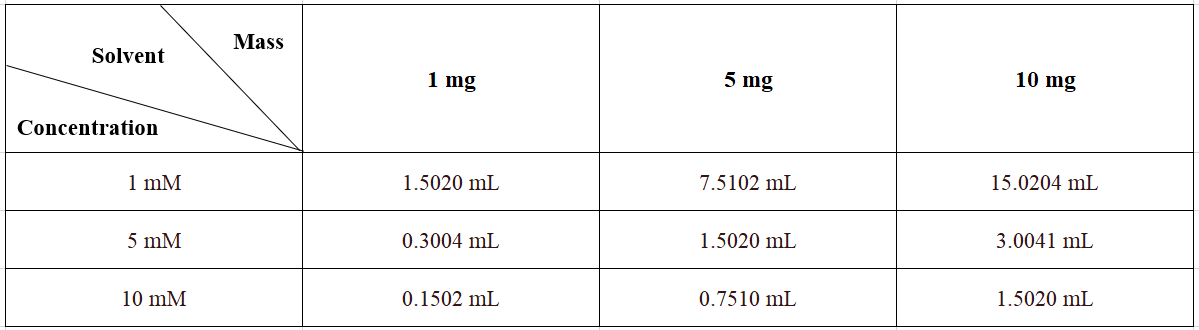
Prepare a stock solution in an appropriate solvent based on the product's solubility in different solvents. Once prepared, aliquot and store to avoid product loss due to repeated freeze-thaw cycles.
Stock solution storage and expiration date: -80℃, 2 years; -20℃, 1 year. When stored at -80℃, use within 2 years; when stored at -20℃, use within 1 year.
2. Animal Experiment
Please select the appropriate dissolution method based on your experimental animals and administration method.
For the following dissolution methods, first prepare a clear stock solution in vitro, then add cosolvents in sequence:
To ensure reliable experimental results, the clear stock solution can be stored appropriately according to storage conditions. For in vivo experiments, it is recommended that the working solution be prepared fresh and used the same day.
The percentages shown before the solvents below refer to the volume percentage of the solvent in the final solution. If precipitation or precipitation occurs during the preparation process, heating and/or sonication can be used to aid dissolution.
Protocol 1
Add each solvent one by one: 10% DMSO, 40% PEG300, 5% Tween-80, 45% Saline
Solubility: ≥ 2.08 mg/mL (3.12 mM); Clear solution
This protocol yields a clear solution of ≥ 2.08 mg/mL (saturation unknown).
Taking 1 mL working solution as an example, add 100 μL DMSO stock solution (20.8 mg/mL) to 400 μL PEG300, and mix evenly; then add 50 μL Tween-80 and mix evenly; then add 450 μL Saline to adjust the volume to 1 mL.
Preparation of Saline: Dissolve 0.9 g sodium chloride in ddH₂O and dilute to 100 mL to obtain a clear Saline solution.
Protocol 2
Add each solvent one by one: 10% DMSO, 90% (20% SBE-β-CD in Saline)
Solubility: ≥ 2.08 mg/mL (3.12 mM); Clear solution
This protocol yields a clear solution of ≥ 2.08 mg/mL (saturation unknown).
Taking 1 mL working solution as an example, add 100 μL DMSO stock solution (20.8 mg/mL) to 900 μL 20% SBE-β-CD in Saline, and mix evenly.
Preparation of 20% SBE-β-CD in Saline (4°C, storage for one week): 2 g SBE-β-CD powder is dissolved in 10 mL Saline, completely dissolve until clear.
Protocol 3
Add each solvent one by one: 10% DMSO, 90% Corn Oil
Solubility: ≥ 2.08 mg/mL (3.12 mM); Clear solution
This protocol yields a clear solution of ≥ 2.08 mg/mL (saturation unknown). If the continuous dosing period exceeds half a month, please choose this protocol carefully.
Taking 1 mL working solution as an example, add 100 μL DMSO stock solution (20.8 mg/mL) to 900 μL Corn oil, and mix evenly.
Pharmacodynamics
Rilzabrutinib is a kinase inhibitor that works by modulating the immune pathways. Rilzabrutinib has a short duration of systemic exposure with a long duration of action on the target due to its slow dissociation from BTK. At therapeutic doses in healthy participants, durable BTK occupancy in peripheral blood mononuclear cells was observed over a 24-hour period.
Mechanism Of Action
Immune thrombocytopenia (ITP) is an autoimmune disorder characterized by a low platelet count, bruising, and bleeding events. It results from a complex dysregulation of the immune system that leads to both increased destruction of circulating platelets and impaired platelet production. One primary mechanism involves the production of autoantibodies, typically of the IgG class, which bind to glycoproteins on the surface of platelets. This binding marks the platelets for clearance, primarily through phagocytosis by macrophages in the spleen and liver. This process is mediated by the binding of the Fc portion of the autoantibodies to Fcγ receptors (FcγR) on macrophages. Another key pathway involves the role of Bruton's tyrosine kinase (BTK), an intracellular signalling molecule expressed in various immune cells, including B cells, macrophages, and mast cells. In ITP, BTK signalling contributes to the production of anti-platelet autoantibodies by B cells and to the FcγR-mediated destruction of platelets by macrophages. Through reversible and covalent inhibition of BTK, rilzabrutinib inhibits B cell activation and interrupts antibody-coated cell phagocytosis by Fcγ receptor (FcγR) in spleen and liver. In vitro, rilzabrutinib reduced autoantibody signaling mediated through the FcγR pathway, blocked B cell signaling, and decreased autoantibody generation through effects on B cell activation.
Similar Products
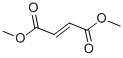
Dimethyl Fumarate
Therapy
: Immune-Inflammatory diseases
Target
: Nrf2
CAS
: 624-49-7
MF
: C6H8O4
MW
: 144.13
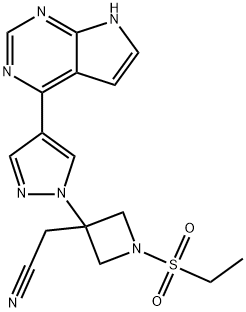
Baricitinib
Therapy
: Immune-Inflammatory diseases
Target
: JAK1;JAK2
CAS
: 1187594-09-7
MF
: C16H17N7O2S
MW
: 371.42
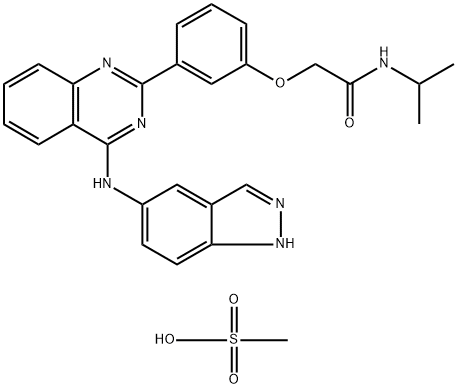
Belumosudil Mesylate
Therapy
: Immune-Inflammatory diseases
Target
: ROCK
CAS
: 2109704-99-4
MF
: C27H28N6O5S
MW
: 548.62
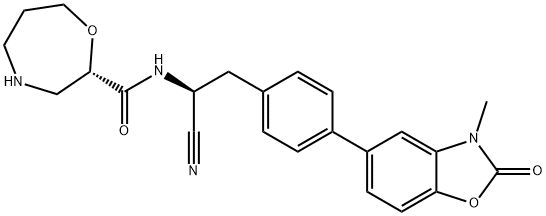
Brensocatib
Therapy
: Immune-Inflammatory diseases
Target
: CTSC
CAS
: 1802148-05-5
MF
: C23H24N4O4
MW
: 420.47