
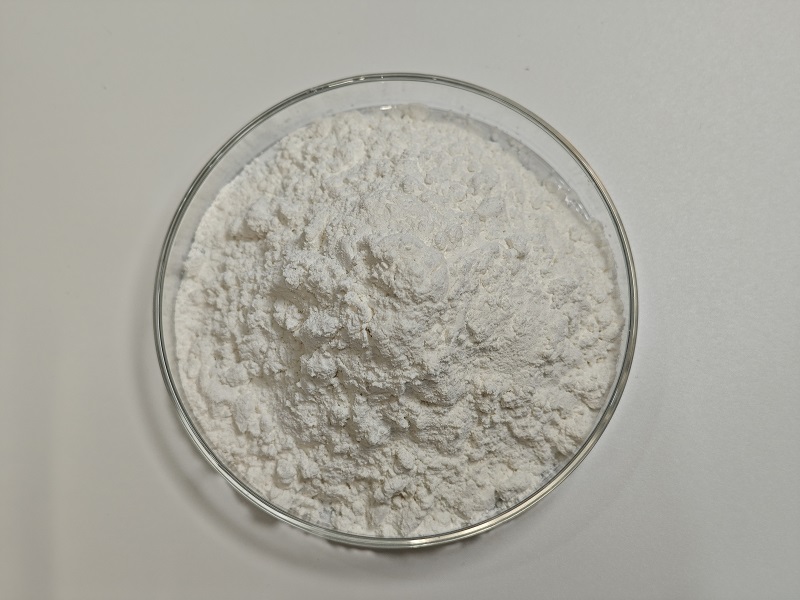
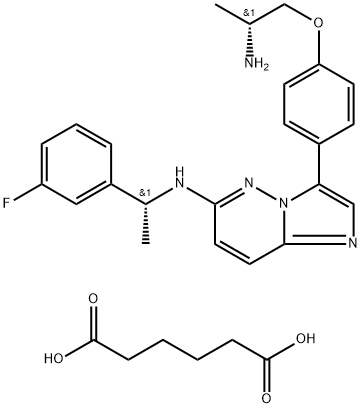
Vorasidenib
A dual inhibitor of mutant isocitrate dehydrogenase 1 and 2 (IDH1/2) enzymes; used for the treatment of relapsed or refractory acute myeloid leukemia (AML) and IDH-mutated cholangiocarcinoma.
概况
Vorasidenib is a isocitrate dehydrogenase type 1 (IDH1) and 2 (IDH2) inhibitor used to treat Grade 2 astrocytoma or oligodendroglioma with a susceptible IDH1 or IDH2 mutation.
Synonyms: AG-881; AGI-23088; S-95032; S95032; VORANIGO; Vorasidenib citrate
Product Categories: Antineoplastic Agents; BCRP/ABCG2 Inhibitors; Cytochrome P-450 CYP2B6 Inducers; Isocitrate dehydrogenase (IDH) inhibitors
Mol File: 1644545-52-7.mol
物化性质
Boiling point: 467.5±55.0°C(Predicted)
Storage temp: -20°C
Solubility: DMF: 30 mg/mL; DMSO: 30 mg/mL; DMSO: PBS (pH 7.2) (1:2): 0.33 mg/mL
Form: A Crystalline Solid
Color: Light Yellow to Light Brown
MSDS信息
实验数据
1. Cell Experiment
DMSO: 100 mg/mL (241.11 mM; Ultrasonic required)
Preparing Stock Solutions:
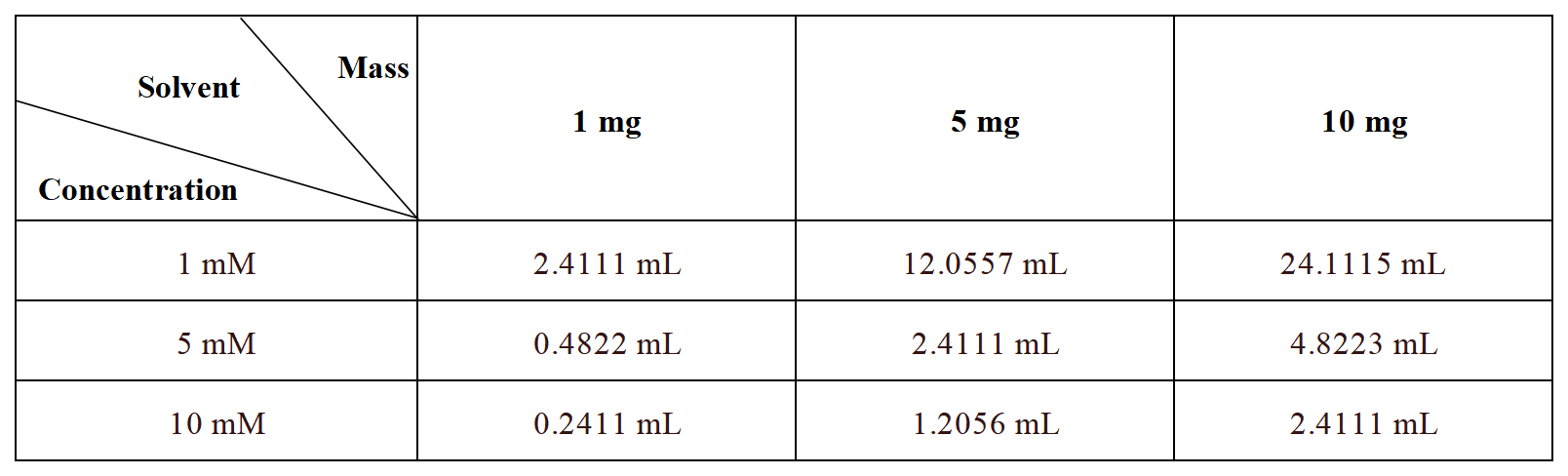
Please prepare the stock solution in the appropriate solvent based on the product's solubility in different solvents. Once dissolved, aliquot the solution to avoid product inactivation caused by repeated freeze-thaw cycles.
Storage method and shelf life of the stock solution: -80°C, 1 year; -20°C, 6 months. When stored at -80°C, please use within 1 year; when stored at -20°C, please use within 6 months.
2. Animal Experiment
Please select the appropriate dissolution protocol based on your experimental animals and administration method. For the following protocols, first prepare a clear stock solution in vitro, then add co-solvents in sequence:
To ensure reliable experimental results, the clear stock solution can be stored appropriately according to the storage conditions. For in vivoexperiments, it is recommended to prepare the working solution fresh and use it on the same day.
The percentages indicated before the solvents refer to the volume percentage of each solvent in the final solution. If precipitation occurs during preparation, heating and/or sonication may be used to aid dissolution.
Protocol 1
Add each solvent in the following order: 5% DMSO, 40% PEG300, 5% Tween-80, 50% Saline.
Solubility: 2.5 mg/mL (6.03 mM); Suspended solution; Ultrasonic required.
Protocol 2
Add each solvent in the following order: 5% DMSO, 95% (20% SBE-β-CD in Saline).
Solubility: 2.4 mg/mL (5.79 mM); Suspended solution; Ultrasonic required.
Protocol 3
Add each solvent in the following order: 10% DMSO, 40% PEG300, 5% Tween-80, 45% Saline.
Solubility: 2.08 mg/mL (5.02 mM); Suspended solution; Ultrasonic required.
This protocol yields a homogeneous suspension at 2.08 mg/mL (5.02 mM), suitable for oral and intraperitoneal administration.
Preparation example for a 1 mL working solution:
Take 100 μL of the 20.8 mg/mL clear DMSO stock solution and add it to 400 μL of PEG300, mix well. Then add 50 μL of Tween-80 to the mixture and mix thoroughly. Finally, add 450 μL of normal saline to adjust the volume to 1 mL.
Protocol 4
Add each solvent in the following order: 10% DMSO, 90% (20% SBE-β-CD in Saline).
Solubility: 2.08 mg/mL (5.02 mM); Suspended solution; Ultrasonic required.
This protocol yields a homogeneous suspension at 2.08 mg/mL (5.02 mM), suitable for oral and intraperitoneal administration.
Preparation example for a 1 mL working solution:
Take 100 μL of the 20.8 mg/mL clear DMSO stock solution and add it to 900 μL of a 20% SBE-β-CD solution in saline, mix well.
Protocol 5
Add each solvent in the following order: 10% DMSO, 90% Corn Oil.
Solubility: 2.08 mg/mL (5.02 mM); Clear solution; Warming required.
This protocol yields a clear solution with a concentration of 2.08 mg/mL (5.02 mM). This protocol is not suitable for experiments lasting longer than half a month.
Preparation example for a 1 mL working solution:
Take 100 μL of the 20.8 mg/mL clear DMSO stock solution and add it to 900 μL of corn oil, mix well.
Pharmacodynamics
Vorasidenib works to reduce tumour growth and invasion in IDH-mutant glioma. In patients with low-grade IDH-mutant glioma, vorasidenib significantly improved progression-free survival and delayed the time to the next anticancer intervention.
Vorasidenib decreases 2-HG tumour concentrations in patients with IDH1 or IDH2 mutated glioma. Relative to tumours from patients in the untreated group, the posterior median percentage reduction (95% credible interval) in tumour 2-HG was 64% (22%, 88%) to 93% (76%, 98%) in tumours from patients who received vorasidenib at exposures that were 0.3 to 0.8 times the exposure observed with the highest recommended dosage. The exposure-response relationship and time course of pharmacodynamic response for the safety and effectiveness of vorasidenib have not been fully characterized.
Mechanism Of Action
Mutations in the isocitrate dehydrogenase 1 and 2 (IDH1/2) enzymes can be identified in various malignancies, including acute myeloid leukemia (AML) and gliomas. Mutant enzymes produce an oncometabolite D-2-hydroxyglutarate (2-HG), which contributes to oncogenesis and tumour growth by blocking the activity of α-ketoglutarate–dependent enzymes and causing epigenetic dysregulation, such as global DNA hypermethylation, and interfering with immunity. Vorasidenib is a small molecule inhibitor that targets isocitrate dehydrogenase-1 and 2 (IDH1 and IDH2) enzymes. In vitro, vorasidenib inhibited the IDH1 wild-type and mutant variants, including R132H and the IDH2 wild-type and mutant variants. In cell-based and in vivo tumour models expressing IDH1 or IDH2 mutated proteins, vorasidenib decreased the production of 2-2-HG and partially restored cellular differentiation.
相似产品
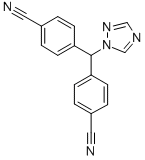
Letrozole
治疗领域
: Oncology
作用靶点
: ERs;Aromatase
CAS
: 112809-51-5
分子式
: C17H11N5
分子量
: 285.3

Toremifene Citrate
治疗领域
: Oncology
作用靶点
: ERs
CAS
: 89778-27-8
分子式
: C26H28ClNO.C6H8O7
分子量
: 598.08
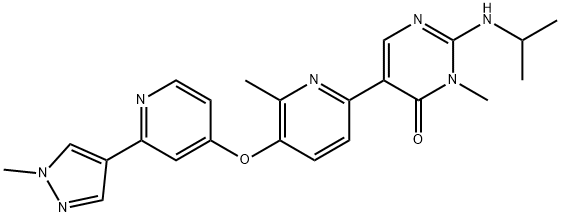
Vimseltinib
治疗领域
: Oncology
作用靶点
: CSF1R
CAS
: 1628606-05-2
分子式
: C23H25N7O2
分子量
: 431.49
Taletrectinib
治疗领域
: Oncology
作用靶点
: ROS; Trk-A; Trk-B; Trk-C
CAS
: 1505515-69-4
分子式
: C29H34FN5O5
分子量
: 551.62