
Lazertinib
A tyrosine kinase inhibitor used in combiantion with amivantamab to treat non-small cell lung cancer with EGFR mutations.
概况
Lazertinib is an oral, third-generation epidermal growth factor receptor (EGFR) tyrosine kinase inhibitor (TKI) that penetrates the central nervous system (CNS) and has been approved in South Korea for the treatment of patients with EGFR T790M mutation-positive non-small cell lung cancer (NSCLC) who have previously received EGFR-TKI therapy.
Synonyms: YH-25448; JNJ-73841937; JNJ-1937; GNS-1480; Leclaza; Lazcluze; lasertinib; 2-PROPENAMIDE, N-(5-((4-(4-((DIMETHYLAMINO)METHYL)-3-PHENYL-1H-PYRAZOL-1-YL)-2-PYRIMIDINYL)AMINO)-4-METHOXY-2-(4-MORPHOLINYL)PHENYL)-; N-(5-((4-(4-((DIMETHYLAMINO)METHYL)-3-PHENYL-1H-PYRAZOL-1-YL)PYRIMIDIN-2-YL)AMINO)-4-METHOXY-2-MORPHOLINOPHENYL)ACRYLAMIDE
Product Categories: Kinase Inhibitor; Protein Kinase Inhibitors; Epidermal growth factor receptor (EGFR) tyrosine kinase inhibitors; Antineoplastic Agents; Antineoplastic and Immunomodulating Agents; Cytochrome P-450 CYP3A4 Substrates/Inhibitors; BCRP/ABCG2 Inhibitors
Mol File: 1903008-80-9.mol
物化性质
Storage temp: -20℃
Solubility: DMSO: 6.5 (maximum concentration mg/mL); 11.72 (maximum concentration mM)
Form: Solid
Color: Light Yellow to Yellow
MSDS信息
实验数据
1. Cell Experiment
DMSO : 3.33 mg/mL (6.00 mM; ultrasonic and warming and heat to 60°C; Hygroscopic DMSO has a significant impact on the solubility of product, please use newly opened DMSO)
Preparing Stock Solutions:
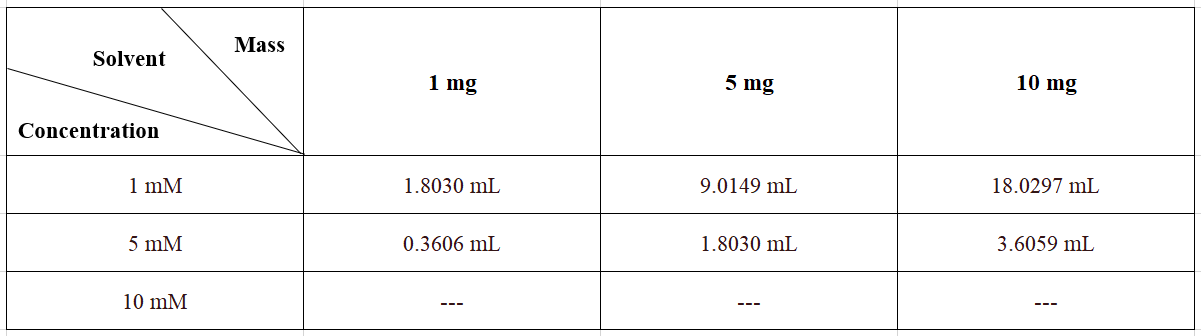
Please refer to the solubility information to select the appropriate solvent. Once prepared, please aliquot and store the solution to prevent product inactivation from repeated freeze-thaw cycles.
Storage method and period of stock solution: -80°C, 2 years; -20°C, 1 year. When stored at -80°C, please use it within 2 years. When stored at -20°C, please use it within 1 year.
2. Animal Experiment
Select the appropriate dissolution method based on your experimental animal and administration route.
For the following dissolution methods, please ensure to first prepare a clear stock solution using an In Vitro approach and then sequentially add co-solvents:
To ensure reliable experimental results, the clarified stock solution can be appropriately stored based on storage conditions. As for the working solution for in vivo experiments, it is recommended to prepare freshly and use it on the same day.
The percentages shown for the solvents indicate their volumetric ratio in the final prepared solution. If precipitation or phase separation occurs during preparation, heat and/or sonication can be used to aid dissolution.
Protocol 1
Add each solvent one by one: 10% DMSO, 40% PEG300, 5% Tween-80, 45% Saline
Solubility: ≥ 0.9 mg/mL (1.62 mM); Clear solution
This protocol yields a clear solution of ≥ 0.9 mg/mL (saturation unknown).
Taking 1 mL working solution as an example, add 100 μL DMSO stock solution (9.0 mg/mL) to 400 μL PEG300, and mix evenly; then add 50 μL Tween-80 and mix evenly; then add 450 μL Saline to adjust the volume to 1 mL.
Preparation of Saline: Dissolve 0.9 g sodium chloride in ddH₂O and dilute to 100 mL to obtain a clear Saline solution.
Protocol 2
Add each solvent one by one: 10% DMSO, 90% (20% SBE-β-CD in Saline)
Solubility: ≥ 0.9 mg/mL (1.62 mM); Clear solution
This protocol yields a clear solution of ≥ 0.9 mg/mL (saturation unknown).
Taking 1 mL working solution as an example, add 100 μL DMSO stock solution (9.0 mg/mL) to 900 μL 20% SBE-β-CD in Saline, and mix evenly.
Preparation of 20% SBE-β-CD in Saline (4°C, storage for one week): 2 g SBE-β-CD powder is dissolved in 10 mL Saline, completely dissolve until clear.
Protocol 3
Add each solvent one by one: 10% DMSO, 90% Corn Oil
Solubility: ≥ 0.9 mg/mL (1.62 mM); Clear solution
This protocol yields a clear solution of ≥ 0.9 mg/mL (saturation unknown). If the continuous dosing period exceeds half a month, please choose this protocol carefully.
Taking 1 mL working solution as an example, add 100 μL DMSO stock solution (9.0 mg/mL) to 900 μL Corn oil, and mix evenly.
Pharmacodynamics
Lazertinib is an anticancer agent. In human NSCLC cells and mouse xenograft models of EGFR exon 19 deletions or EGFR L858R substitution mutations, lazertinib demonstrated antitumour activity. Treatment with lazertinib in combination with amivantamab increased in vivo antitumour activity compared to either agent alone in a mouse xenograft model of human NSCLC with an EGFR L858R mutation.
Mechanism Of Action
Lazertinib is a kinase inhibitor of mutant epidermal growth factor receptor (EGFR). It targets EGFR single (Ex19del, L858R, T790M) and double (Ex19del/T790M and L858R/T790M) mutations. The inhibition of wild-type EGFR by lazertinib is less selective and potent. Lazertinib irreversibly inhibits EGFR by forming a covalent bond to the Cys797 residue in the ATP-binding site of the EGFR kinase domain. It blocks the EGFR downstream signalling cascades - including the phosphorylation of EGFR, AKT and ERK - and promotes apoptosis of EGFR-mutant lung cancer cells.
相似产品

Amifostine
治疗领域
: Oncology
作用靶点
: Alkaline phosphatase
CAS
: 20537-88-6
分子式
: C5H15N2O3PS
分子量
: 214.22

Carboplatin
治疗领域
: Oncology
作用靶点
: DNA
CAS
: 41575-94-4
分子式
: C6H12N2O4Pt
分子量
: 371.25
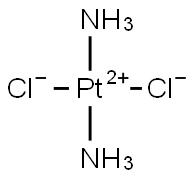
Cisplatin
治疗领域
: Oncology
作用靶点
: DNA
CAS
: 15663-27-1
分子式
: Cl2H6N2Pt
分子量
: 300.04
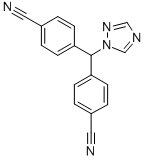
Letrozole
治疗领域
: Oncology
作用靶点
: ERs;Aromatase
CAS
: 112809-51-5
分子式
: C17H11N5
分子量
: 285.3