
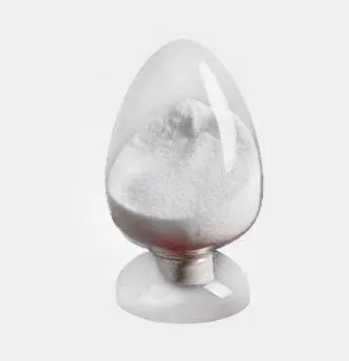
Brexpiprazole
Atypical antipsychotic; used to treat schizophrenia and as an augmentation agent for antidepressants.
概况
Brexpiprazole is an effective oral atypical antipsychotic drug. It functions as a partial agonist at dopamine D2 receptors and serotonin 1A receptors, and simultaneously exerts antagonistic effects at serotonin 2A receptors. Brexpiprazole can be used in the research of schizophrenia, adjunctive treatment of major depressive disorder, and other related psychiatric disorders.
Synonyms: Lu-AF41156; OPDC-34712; OPC-34712; OPC-34712 FUM; Rxulti; Rexulti; Rexultiod; Brexpiprazol; Brexpiprazolum; Brexpiprazole impurity a; 7-[4-(4-benzo[b]thien-4-yl-1-piperazinyl)butoxy]- 2(1H)-Quinolinone
EINECS: 811-628-7
Product Categories: Piperazines; Dopamine D2 receptor partial agonist; Pharmaceutical APIs; Small molecule inhibitors; Epizotocin intermediates; Pharmaceutical intermediates; Inhibitors
Mol File: 913611-97-9.mol
物化性质
Melting point: 179-181℃
Storage temp: 2-8℃
Solubility: Dichloromethane (slightly soluble); Chloroform (slightly soluble); Methanol (slightly soluble)
Form: Powder
Color: White to Off-white
Stability: Relatively Stable
MSDS信息
实验数据
1. Cell Experiment
DMSO : 25 mg/mL (57.66 mM; ultrasonic and warming and heat to 80°C; Hygroscopic DMSO has a significant impact on the solubility of product, please use newly opened DMSO.
Preparing Stock Solutions:
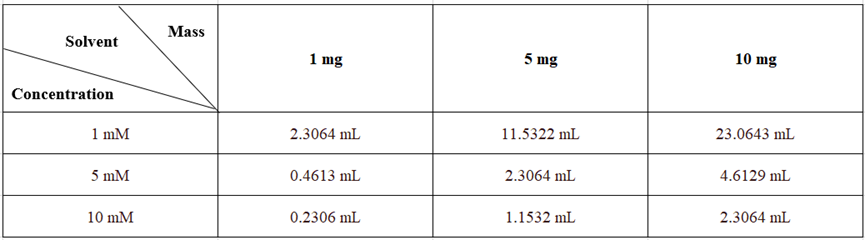
Please refer to the solubility information to select the appropriate solvent. Once prepared, please aliquot and store the solution to prevent product inactivation from repeated freeze-thaw cycles.
Storage method and period of stock solution: -80°C, 2 years; -20°C, 1 year. When stored at -80°C, please use it within 2 years. When stored at -20°C, please use it within 1 year.
2. Animal Experiment
Select the appropriate dissolution method based on your experimental animal and administration route.
For the following dissolution methods, please ensure to first prepare a clear stock solution using an In Vitro approach and then sequentially add co-solvents:
To ensure reliable experimental results, the clarified stock solution can be appropriately stored based on storage conditions. As for the working solution for in vivo experiments, it is recommended to prepare freshly and use it on the same day.
The percentages shown for the solvents indicate their volumetric ratio in the final prepared solution. If precipitation or phase separation occurs during preparation, heat and/or sonication can be used to aid dissolution.
Protocol 1
Add each solvent one by one: 10% DMSO, 90% (20% SBE-β-CD in Saline)
Solubility: 2.5 mg/mL (5.77 mM); Suspended solution; Need ultrasonic
This protocol yields a suspended solution of 2.5 mg/mL. Suspended solution can be used for oral and intraperitoneal injection.
Taking 1 mL working solution as an example, add 100 μL DMSO stock solution (25.0 mg/mL) to 900 μL 20% SBE-β-CD in Saline, and mix evenly.
Preparation of 20% SBE-β-CD in Saline (4°C, storage for one week): 2 g SBE-β-CD powder is dissolved in 10 mL Saline, completely dissolve until clear.
Protocol 2
Add each solvent one by one: 10% DMSO, 90% Corn Oil
Solubility: ≥ 2.5 mg/mL (5.77 mM); Clear solution
This protocol yields a clear solution of ≥ 2.5 mg/mL (saturation unknown). If the continuous dosing period exceeds half a month, please choose this protocol carefully.
Taking 1 mL working solution as an example, add 100 μL DMSO stock solution (25.0 mg/mL) to 900 μL Corn oil, and mix evenly.
Pharmacodynamics
Brexpiprazole is an atypical antipsychotic agent used to ameliorate the symptoms of psychiatric conditions, such as cognitive deficits and affective symptoms. Brexpiprazole has affinity (expressed as Ki) for multiple monoaminergic receptors including serotonin 5-HT1A (0.12 nM), 5-HT2A (0.47 nM), 5-HT2B (1.9 nM), 5-HT7 (3.7 nM), dopamine D2 (0.30 nM), D3 (1.1 nM), and noradrenergic α1A (3.8 nM), α1B (0.17 nM), α1D (2.6 nM), and α2C (0.59 nM) receptors. Brexpiprazole acts as a partial agonist at the 5-HT1A, D2, and D3 receptors and as an antagonist at 5-HT2A, 5-HT2B, 5-HT7, α1A, α1B, α1D, and α2C receptors. Brexpiprazole also exhibits affinity for histamine H1 receptor (19 nM) and for muscarinic M1 receptor (67% inhibition at 10 µM).
Mechanism Of Action
Brexpiprazole is an atypical antipsychotic agent used to ameliorate the symptoms of psychiatric conditions, such as cognitive deficits and affective symptoms. Brexpiprazole has affinity (expressed as Ki) for multiple monoaminergic receptors including serotonin 5-HT1A (0.12 nM), 5-HT2A (0.47 nM), 5-HT2B (1.9 nM), 5-HT7 (3.7 nM), dopamine D2 (0.30 nM), D3 (1.1 nM), and noradrenergic α1A (3.8 nM), α1B (0.17 nM), α1D (2.6 nM), and α2C (0.59 nM) receptors. Brexpiprazole acts as a partial agonist at the 5-HT1A, D2, and D3 receptors and as an antagonist at 5-HT2A, 5-HT2B, 5-HT7, α1A, α1B, α1D, and α2C receptors. Brexpiprazole also exhibits affinity for histamine H1 receptor (19 nM) and for muscarinic M1 receptor (67% inhibition at 10 µM).
相似产品
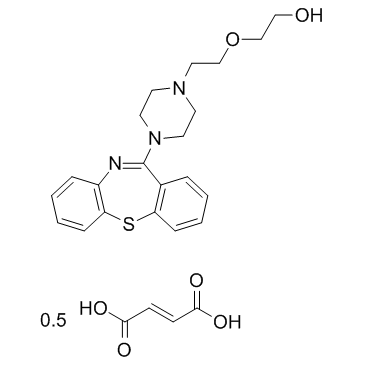
Quetiapine Fumarate
治疗领域
: Central nervous system and pain
作用靶点
: 5-HT2A;DRD2
CAS
: 111974-72-2
分子式
: C21H25N3O2S•1/2(C4H4O4)
分子量
: 441.55
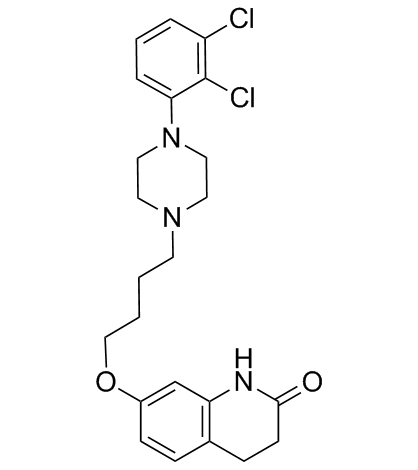
Aripiprazole
治疗领域
: Central nervous system and pain
作用靶点
: 5-HT1A;DRD3;5-HT7;DRD4;5-HT2C;5-HT2A;ADRA1A;DRD2;HRH1
CAS
: 129722-12-9
分子式
: C23H27Cl2N3O2
分子量
: 448.39
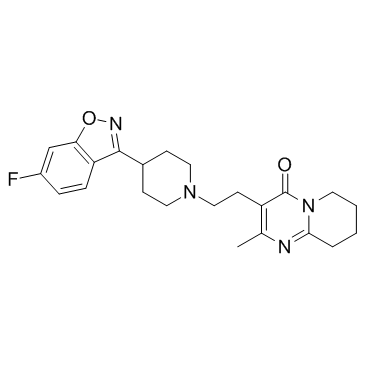
Risperidone
治疗领域
: Central nervous system and pain
作用靶点
: 5-HT2A;DRD2
CAS
: 106266-06-2
分子式
: C23H27FN4O2
分子量
: 410.48
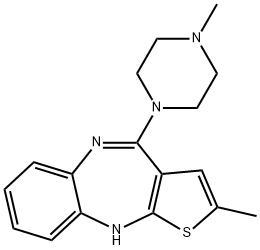
Olanzapine
治疗领域
: Central nervous system and pain
作用靶点
: 5-HT2;DRD1;DRD2
CAS
: 132539-06-1
分子式
: C17H20N4S
分子量
: 312.43