
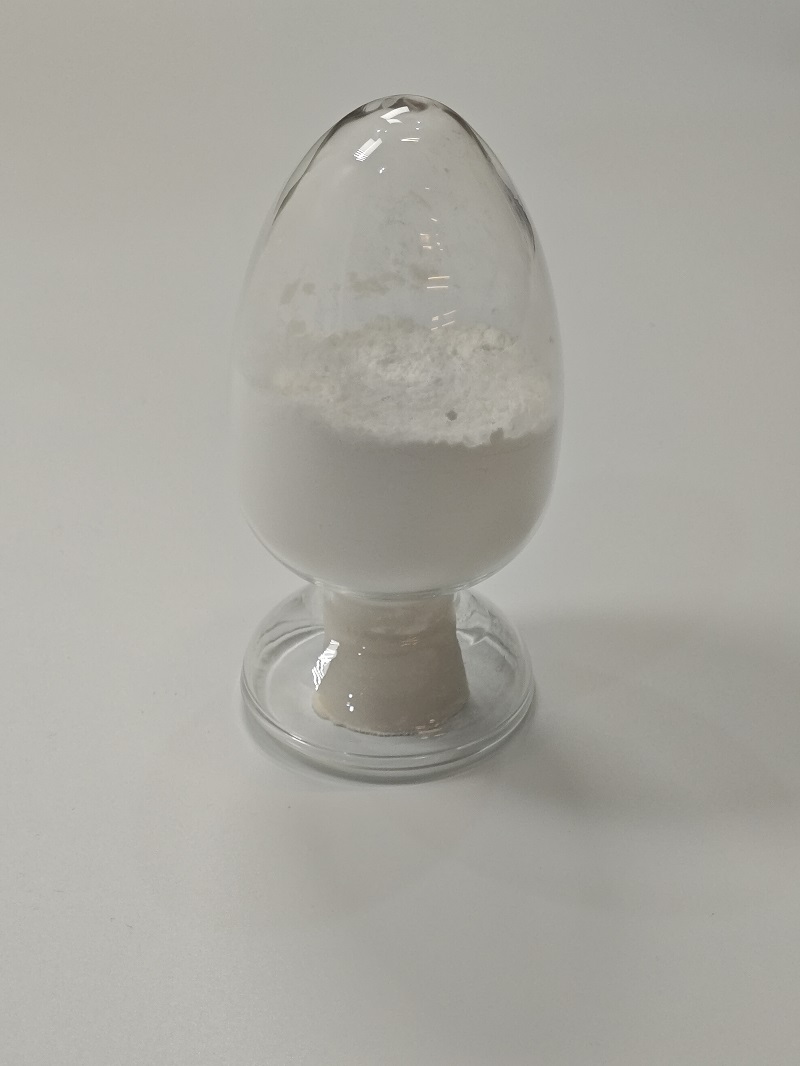
Levacetylleucine
A chemically modified amino acid derivative, mainly used for the treatment of neurological diseases.
Overview
Levacetylleucine is an effective oral non-steroidal compound that exerts neuroprotective and neurofunctional regulatory effects, with a core mechanism related to improving neuronal energy metabolism and balancing neurotransmitter signaling. Levacetylleucine can be used in the research of hereditary cerebellar ataxia, multiple system atrophy, acute vestibular syndrome, and other neurodegenerative/functional balance disorders.
Synonyms: AKOS BBS-00004735; ACETYL-DL-LEUCINE, N-; ACETYL-DL-LEUCINE; ACETYL-L-LEUCINE; AC-DL-LEU-OH; AC-LEUCINE; AC-LEU-OH; IFLAB-BB F0777-0821; V-0251; IB1001(Intrabio); AQNEURSA; Acetyl-L-leucine; N-acetyl-L-leucine; L-Acetylleucine
EINECS: 214-706-3
Product Categories: N-Acetyl-Amino acid series; Amino Acid Derivatives; Leucine [Leu, L]; Amino Acids and Derivatives; Leucine; Peptide Synthesis; Amino Acids Derivatives; Amino Acid Derivatives; Amino Acids; Ac-Amino Acids; Amino Acids (N-Protected); Biochemistry; amino acid; amino; bc0001; 1188-21-2
Mol File: 1188-21-2.mol
Physicochemical Properties
Melting Point: 187-190°C(lit.)
Storage temp: Sealed in dry, Room Temperature
Solubility: DMSO (Slightly), Ethanol (Slightly), Water (Slightly, Heated)
Form: Crystalline Powder
Color: White
MSDS Information
Experimental Data
1. Cell Experiment
Solubility in DMSO : 100 mg/mL (577.33 mM; ultrasonic co-solubilization; Hygroscopic DMSO has a significant effect on the solubility of the product, use freshly opened DMSO)
Preparing Stock Solutions:
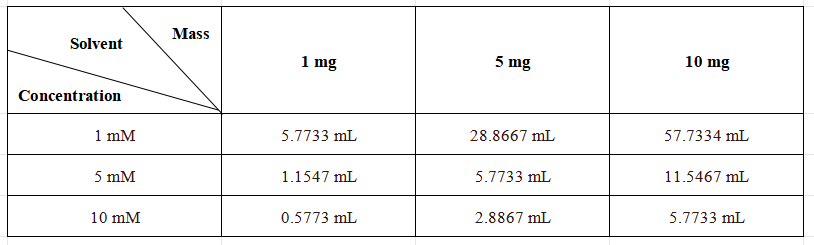
Please choose the appropriate solvent to prepare the stock solution according to the solubility of the product in different solvents; Once prepared into a solution, please store it in separate packages to avoid product failure caused by repeated freezing and thawing.Storage method and duration of stock solution: -80°C, 2 years; -20°C, 1 year。 Use within 2 years when stored at -80°C, and within 1 year when stored at -20°C.
2. Animal Control
Choose the appropriate dissolution protocol based on your experimental animal and mode of administration.
For the following dissolution schemes, please prepare the clarified stock solution according to the in vitro method, and then add the co-solvent in turn:
- In order to ensure the reliability of the experimental results, the clarified stock solution can be properly stored according to the storage conditions; It is recommended that you use the working solution for in vivo experiments and use it on the same day;
The percentages shown before the following solvents are the proportion of the volume of that solvent in your final solution; If precipitation and precipitation occur during the preparation process, it can be dissolved by heating and/or ultrasound.
Option 1
Add each solvent in order: 10% DMSO , 40% PEG300 , 5% Tween-80, 45% Saline.
Solubility: ≥ 2.5 mg/mL (14.43 mM); Clear Solution
A clarified solution of ≥ 2.5 mg/mL (saturation unknown) is obtained for this protocol.
For example, take 1 mL of working solution and add 100 μL of 25.0 mg/mL of clarified DMSO stock solution to 400 μL of PEG300 and mix well. Add 50 μL of Tween-80 to the above system and mix well; Then proceed with 450 μL of normal saline to 1 mL.
Preparation of normal saline: 0.9 g of sodium chloride dissolved in ddH₂O and fixed to 100 mL can obtain a clear and transparent normal saline solution.
Option 2
add each solvent in order: 10% DMSO;90% (20% SBE-β-CD in Saline).
Solubility: ≥ 2.5 mg/mL (14.43 mM); Clear Solution.
A clarified solution of ≥ 2.5 mg/mL (saturation unknown) is obtained for this protocol.
For example, take 1 mL of working solution and add 100 μL of 25.0 mg/mL of clarified DMSO stock solution to 900 μL of 20% SBE-β-CD saline aqueous and mix well.
2 g of SBE-β-CD (sulfonbutyl ether β-cyclodextrin) powder is set in 10 mL of normal saline and completely dissolved until clear.
Option 3
Add each solvent in order: 10% DMSO , 90% Corn Oil.
Solubility: ≥ 2.5 mg/mL (14.43 mM); Clear solution
A clarified solution of ≥ 2.5 mg/mL (saturation unknown) is available for this protocol, as appropriate for animal experiments with experimental cycles of more than half a month.
For example, 100 μL of 25.0 mg/mL of clarified DMSO stock solution is added to 900 μL of corn oil and mixed well.
Pharmacodynamics
The pharmacodynamics of levacetylleucine are not well characterized. There does not appear to be a relationship between increasing levacetylleucine exposure and clinical efficacy.
Mechanism Of Action
Following oral administration, levacetylleucine is taken up via ubiquitously expressed monocarboxylate transporters and distributed to all body tissues.It enters enzyme-controlled pathways that correct metabolic dysfunction and improves adenosine triphosphate (ATP) energy production.The normalization of energy metabolism ameliorates mitochondrial and lysosomal dysfunction and leads to a reduction in the storage of unesterified cholesterol and sphingolipids.Levacetylleucine has also been shown to normalize neuronal membrane potentials in a guinea pig model, thereby improving cellular signaling processes and restoring and protecting neuronal circuits. The specific molecular target of levacetylleucine in the context of Niemann-Pick disease type C (NPC) is unknown.
Similar Products

Levetiracetam
Therapy
: Central nervous system and pain
Target
: SV2A
CAS
: 102767-28-2
MF
: C8H14N2O2
MW
: 170.21
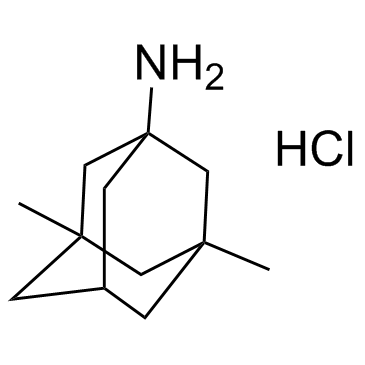
Memantine HCl
Therapy
: Central nervous system and pain
Target
: NMDAR
CAS
: 41100-52-1
MF
: C12H21N•HCl
MW
: 215.76
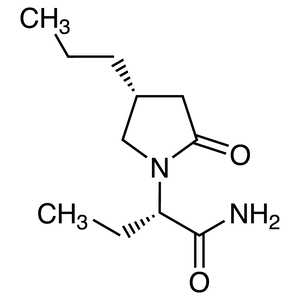
Brivaracetam
Therapy
: Central nervous system and pain
Target
: SV2A
CAS
: 357336-20-0
MF
: C11H20N2O2
MW
: 212.29
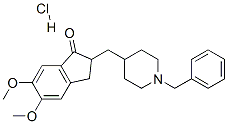
Donepezil Hydrochloride
Therapy
: Central nervous system and pain
Target
: AChE
CAS
: 120011-70-3
MF
: C24H30ClNO3
MW
: 415.95