
Elafibranor
A peroxisome proliferator-activated receptor agonist used to treat primary biliary cholangitis in adults with intolerance of inadequate response to ursodeoxycholic acid.
Overview
Elafibranor is a dual peroxisome proliferator-activated receptor (PPAR) α and β/δ agonist 2 that works to inhibit bile acid synthesis.4 On June 10, 2024, elafibranor was granted accelerated approval by the FDA for the treatment of primary biliary cholangitis (PBC).5 The drug was also approved by the EMA on September 23, 2024.
Synonyms: GFT-505; 2J3H5C81A5 (UNII code); Iqirvo; Elafibranorum; PROPANOIC ACID, 2-(2,6-DIMETHYL-4-((1E)-3-(4-(METHYLTHIO)PHENYL)-3-OXO-1-PROPEN-1-YL)PHENOXY)-; PROPANOIC ACID, 2-(2,6-DIMETHYL-4-(3-(4-(METHYLTHIO)PHENYL)-3-OXO-1-PROPEN-1-YL)PHENOXY)-2-METHYL-
Mol File: 824932-88-9.mol
Physicochemical Properties
Melting point: 140-144°C
Boiling point: 569.0±50.0°C (Predicted)
Density: 1.21±0.1 g/cm³ (Predicted)
Storage conditions: Amber Vial, -20°C Freezer
Solubility: Slightly soluble in DMSO, slightly soluble in methanol
Form: Solid
Acidity coefficient (pKa): 3.34±0.11 (Predicted)
Color: Viscous Yellow
Stability: Photosensitive
MSDS Information
Experimental Data
1. Cell experiment
Solubility in DMSO: ≥ 33 mg/mL (85.83 mM; Hygroscopic DMSO has a significant impact on the solubility of the product, please use newly opened DMSO)
Preparing Stock Solutions:
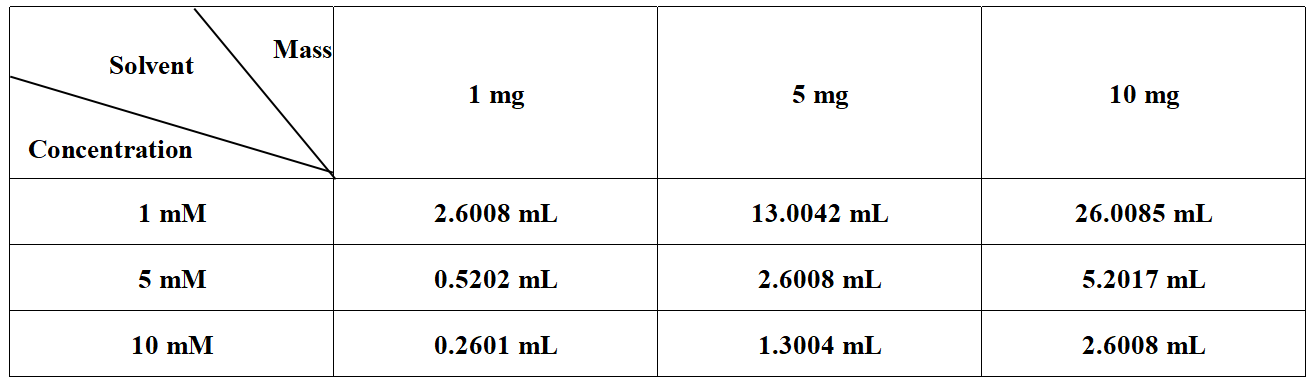
"≥" means soluble, but saturation unknown.
View complete stock solution preparation table
Please select an appropriate solvent to prepare the stock solution based on the solubility of the product in different solvents. Once prepared, aliquot and store to avoid product failure caused by repeated freeze-thaw cycles.
Storage method and duration of stock solution: -80°C, 1 year; -20°C, 6 months. When stored at -80°C, use within 1 year; when stored at -20°C, use within 6 months.
2. Animal experiment
Please select an appropriate dissolution scheme based on your experimental animals and route of administration.
The following dissolution schemes all require first preparing a clear stock solution according to the In Vitro method, followed by sequential addition of co-solvents:
—To ensure the reliability of experimental results, the clear stock solution can be stored appropriately according to storage conditions; for in vivo working solutions, it is recommended to prepare them fresh and use on the same day.
The percentage displayed before each solvent indicates the volume ratio of that solvent in the final solution you prepare; if precipitation or crystallization occurs during preparation, it can be resolved by heating and/or ultrasonication.
Scheme 1
Please add each solvent in sequence: 10% DMSO, 90% (20% SBE-β-CD in Saline)
Solubility: 2.17 mg/mL (5.64 mM); Suspension; Ultrasonic assistance is required.
This scheme yields a uniform suspension of 2.17 mg/mL, which can be used for oral and intraperitoneal injection.
Taking 1 mL of working solution as an example: add 100 μL of 21.7 mg/mL clear DMSO stock solution to 900 μL of 20% SBE-β-CD in saline, and mix well.
Dissolve 2 g of SBE-β-CD (sulfobutylether β-cyclodextrin) powder in normal saline to a volume of 10 mL, and dissolve completely until clear and transparent.
Pharmacodynamics
Elafibranor inhibits bile acid synthesis. It was also shown to improve insulin sensitivity, glucose homeostasis, and lipid metabolism.In patients with PBC, elafibranor reduced the mean levels of alkaline phosphatase (ALP).
An in vitro PPAR functional assay showed that both elafibranor and GFT1007 produced activation of PPARalpha (EC50 = 46 nM and 14 nM, respectively, and Emax = 56% and 61%, respectively, relative to reference agonists). The potency of elafibranor and GFT1007 for PPAR-alpha activation exceeded the respective potencies for PPAR-gamma and PPAR-delta activation by approximately 3- to 8-fold
Mechanism Of Action
Proliferator-activated receptor (PPAR) is a nuclear receptor that regulates numerical cellular processes, including lipid metabolism and inflammation.Different subtypes of PPARs have different roles and functions, and two of these subtypes - PPAR-alpha (α) and PPAR-delta (δ) (also known as PPARβ) - have been identified as therapeutic targets for diabetes and lipid disorders. PPARα controls lipid flux in the liver and regulates plasma levels of triglycerides and high-density lipoprotein (HDL) cholesterol. PPARδ activation leads to fatty acid transport and oxidation, increased HDL levels, and improved glucose homeostasis. PPARα and PPARδ also mediate anti-inflammatory actions
Similar Products
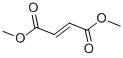
Dimethyl Fumarate
Therapy
: Immune-Inflammatory diseases
Target
: Nrf2
CAS
: 624-49-7
MF
: C6H8O4
MW
: 144.13
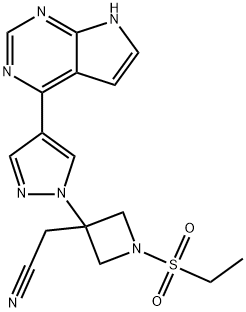
Baricitinib
Therapy
: Immune-Inflammatory diseases
Target
: JAK1;JAK2
CAS
: 1187594-09-7
MF
: C16H17N7O2S
MW
: 371.42
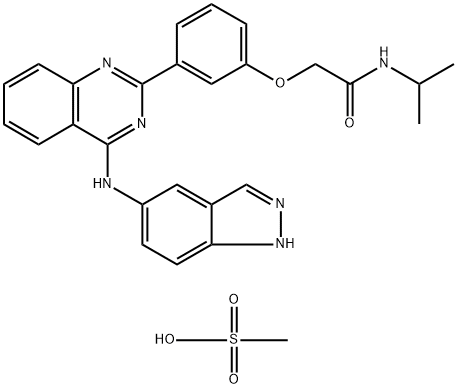
Belumosudil Mesylate
Therapy
: Immune-Inflammatory diseases
Target
: ROCK
CAS
: 2109704-99-4
MF
: C27H28N6O5S
MW
: 548.62
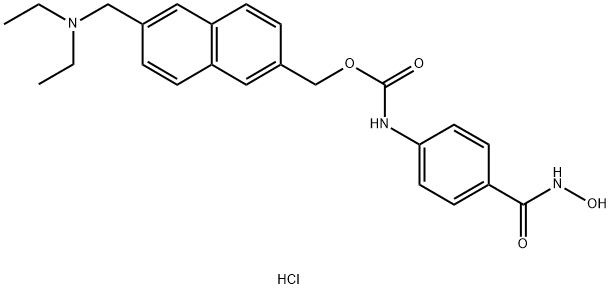
Givinostat hydrochloride
Therapy
: Immune-Inflammatory diseases
Target
: HDAC1; HDAC3
CAS
: 199657-29-9
MF
: C24H28ClN3O4
MW
: 457.96