
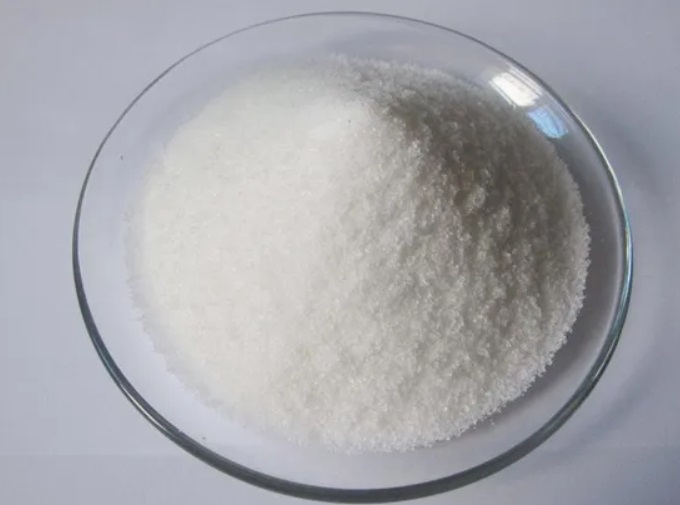
Vitamin D2
A vitamin often used to prevent and treat rickets.
Overview
Vitamin D2 (ergocalciferol) is an important fat-soluble vitamin that plays a key role in regulating calcium and phosphorus metabolism, promoting intestinal calcium absorption, and maintaining normal bone function. Vitamin D2 can be used to study vitamin D deficiency, rickets in children, osteomalacia and osteoporosis in adults, and immune regulation mechanisms.
Synonyms: Ergocalciferol; Calciferol; Activated ergosterol; Ergocalciférol; Ergocalciferolum; Oleovitamin D2; Viosterol; Vitamin D-2; Vitamina D2; (3β,5Z,7E,22E)-9,10-secoergosta-5,7,10(19),22-tetraen-3-ol; (5Z,7E,22E)-(3S)-9,10-seco-5,7,10(19),22-ergostatetraen-3-ol; (5Z,7E,22E)-(3S)-9,10-secoergosta-5,7,10(19),22-tetraen-3-ol
EINECS: 200-014-9
Product Categories: Chiral reagents; Vitamins; Intermediates & Fine Chemicals; Mainly used for the prevention and treatment of rickets osteomalacia baby brothers tetany, etc; Inhibitors; API
Mol File: 50-14-6.mol
Physicochemical Properties
Melting point: 114-118℃
Storage temp: 2-8°C
Solubility: Soluble in ethanol, methanol, dimethylformamide, and dimethyl sulfoxide
Form: Powder
Color: White to Light Yellow
Stability: Light Sensitive
MSDS Information
Experimental Data
1. Cell Experiment
Solubility in DMSO: 31.25 mg/mL (78.78 mM; sonication-assisted dissolution; hygroscopic DMSO significantly affects the solubility of the product, so use freshly opened DMSO).
Preparing Stock Solutions:
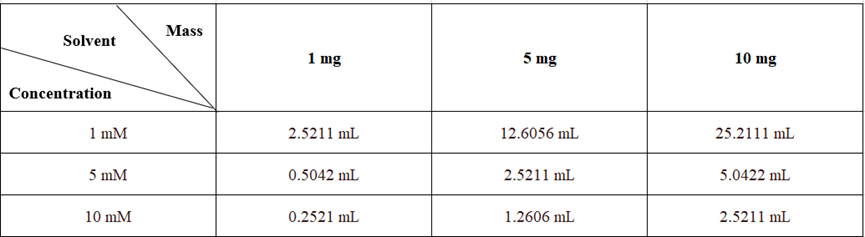
Please prepare the stock solution in the appropriate solvent based on the product's solubility in different solvents. This product is unstable in solution, so it is recommended that you prepare the stock solution immediately.
2. Animal Experiment
Please select the appropriate dissolution method based on your experimental animals and administration method.
For the following dissolution methods, first prepare a clear stock solution in vitro, then add cosolvents in sequence:
- To ensure reliable experimental results, the clear stock solution can be stored appropriately according to storage conditions. For in vivo experiments, it is recommended that the working solution be prepared fresh and used the same day.
The percentages shown before the solvents below refer to the volume percentage of the solvent in the final solution. If precipitation or precipitation occurs during the preparation process, heating and/or sonication can be used to aid dissolution.
Protocol 1
Add each solvent in order: 10% DMSO, 40% PEG300, 5% Tween-80, 45% Saline.
Solubility: ≥ 2.08 mg/mL (5.24 mM); Clear Solution
This protocol produces a clear solution with a concentration of ≥ 2.08 mg/mL (saturation unknown).
For a 1 mL working solution, add 100 μL of the 20.8 mg/mL clear DMSO stock solution to 400 μL of PEG300 and mix thoroughly. Add 50 μL of Tween-80 to the solution and mix thoroughly. Then, add 450 μL of normal saline to bring the volume to 1 mL.
To prepare normal saline: Dissolve 0.9 g of sodium chloride in ddH₂O and dilute to 100 mL. This will yield a clear, transparent normal saline solution.
Protocol 2
Add each solvent in sequence: 10% DMSO, 90% (20% SBE-β-CD in saline)
Solubility: 2.08 mg/mL (5.24 mM); Suspension; Ultrasonic Dissolution
This protocol produces a homogeneous suspension at 2.08 mg/mL suitable for oral and intraperitoneal administration.
For a 1 mL working solution, add 100 μL of the 20.8 mg/mL clear DMSO stock solution to 900 μL of a 20% SBE-β-CD solution in saline and mix thoroughly.
Add 2 g of SBE-β-CD (sulfobutyl ether β-cyclodextrin) powder to 10 mL of saline and dissolve completely until clear and transparent.
Protocol 3
Please add each solvent in the following order: 10% DMSO, 90% corn oil.
Solubility: ≥ 2.08 mg/mL (5.24 mM); Clear solution
This protocol produces a clear solution with a concentration of ≥ 2.08 mg/mL (saturation unknown). This protocol should be used for animal experiments with experimental durations exceeding two weeks.
For a 1 mL working solution, add 100 μL of the 20.8 mg/mL clear DMSO stock solution to 900 μL of corn oil and mix thoroughly.
Pharmacodynamics
After the activation of the vitamin D receptor, some of the biological changes produced by ergocalciferol include mobilization and accretion of calcium and phosphorus in the bone, absorption of calcium and phosphorus in the intestine, and reabsorption of calcium and phosphorus in the kidney.
Some other effects known to be produced due to the presence of vitamin D are osteoblast formation, fetus development, induction of pancreatic function, induction of neural function, improvement of immune function, cellular growth and cellular differentiation.
When compared to its vitamin D counterpart cholecalciferol, ergocalciferol has been shown to present a reduced induction of calcidiol and hence, it is less potent.
Ergocalciferol supplementation in patients with end-stage renal disease has been shown to generate a significant benefit in lab parameters of bone and mineral metabolism as well as improvement in glycemic control, serum albumin levels and reduced levels of inflammatory markers.
Mechanism Of Action
For its activity, ergocalciferol is required to be transformed to its major active circulating hydroxylated metabolite and transported to the target organs in order to bind to its target, the vitamin D receptor. The activation of the vitamin D receptor is part of the vitamin D endocrine system and it is described by the production of a change in the transcription rates of the vitamin D receptor target genes. The target genes in the DNA affected by the presence of ergocalciferol are called vitamin D response elements which are dependent on co-modulators. The vitamin D receptor is a transcription factor and member of the steroid hormone nuclear receptor family. It presents a DNA binding domain (VDRE) that, when activated, recruits coregulatory complexes to regulate the genomic activity. Additionally, ergocalciferol presents nongenomic effects such as the stimulation of intestinal calcium transport via transcaltachia.
Similar Products
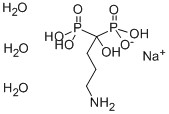
Alendronate Sodium
Therapy
: Bone diseases
Target
: Not applicable
CAS
: 121268-17-5
MF
: C4H13NO7P2.3H2O.Na
MW
: 326.13

Carboplatin
Therapy
: Oncology
Target
: DNA
CAS
: 41575-94-4
MF
: C6H12N2O4Pt
MW
: 371.25
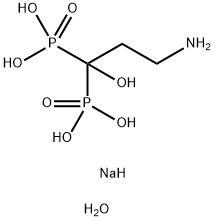
Pamidronate Disodium
Therapy
: Bone diseases
Target
: FDPS;Bone resorption factor
CAS
: 109552-15-0
MF
: C3H14NNaO8P2
MW
: 277.08
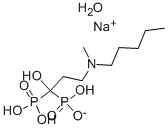
Ibandronate Sodium
Therapy
: Bone diseases
Target
: FDPS;Bone resorption factor
CAS
: 138926-19-9
MF
: C9H24NNaO8P2
MW
: 359.23