Six Major Innovations in Organic Synthesis in October, Enabling New Breakthroughs in Drug Development
Here are some innovative synthetic chemistry technologies to watch in October, recommended by CRO Charles River.
Recently, Charles River, a leading global CRO, released a briefing on key advancements in synthetic chemistry for October, focusing on six practical technological breakthroughs, including pyridine/piperidine isosteric synthesis, one-pot coupling, and free radical strategy optimization. These innovative achievements not only simplify synthetic processes and improve reaction efficiency but also demonstrate significant application value in scenarios such as medicinal chemistry library construction and large-scale preparation of natural products, injecting new momentum into the pharmaceutical R&D industry.
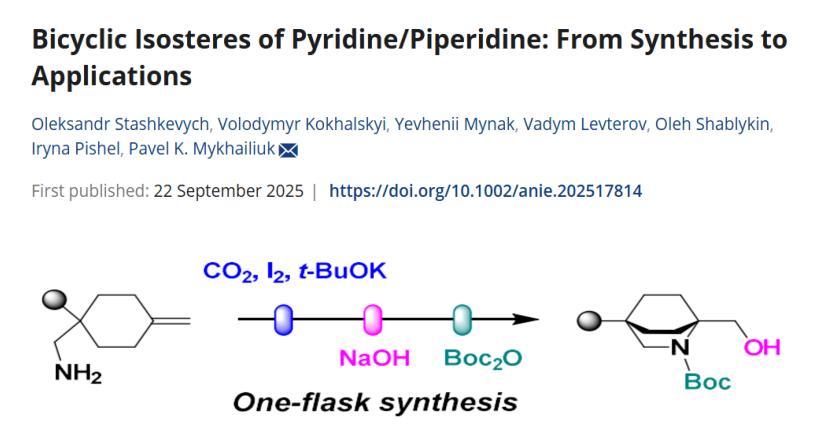
Pyridine/Piperidine Isosteres: From Synthesis to Applications
A one-pot synthetic scheme for 2-azabicyclic [2.2.2]octane and related azabicyclic compounds was successfully developed via iodine-mediated cyclization of cycloalkenylamines with KOtBu/I₂/CO₂. This method is versatile and scalable, producing products up to 20 grams in scale, and has a broad substrate scope, enabling flexible modification of medicinal chemistry building blocks and providing a novel approach for drug molecule structure optimization. The relevant research has been published in Angew. Chem. Int. Ed. (DOI: 10.1002/anie.202517814).
One-Pot Synthesis: Deoxyalkylation of Aryl Bromides
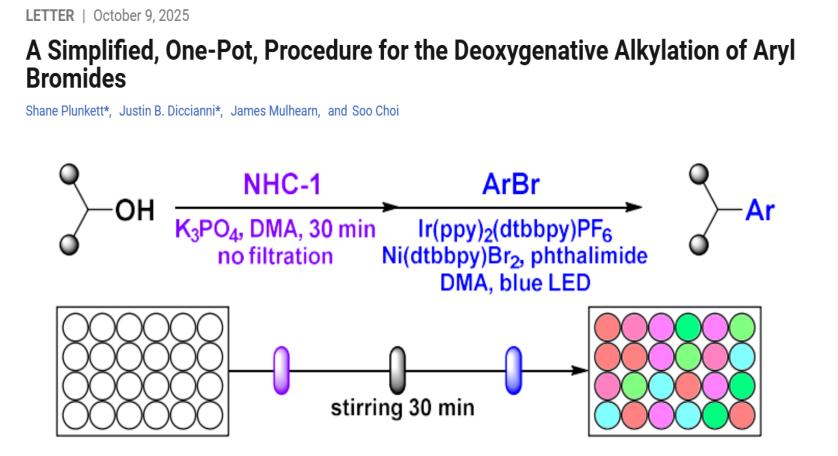
In a dimethylacetamide (DMA) single-solvent system, using K₃PO₄ as a base and N-heterocyclic carbene (NHC) in situ activated alcohols, C(sp²)-C(sp³) deoxyalkylation of aryl bromides with aliphatic alcohols can be achieved without filtration. This method supports parallel reactions in Lumidox 24-well and 96-well plates, requires no excess alcohol or complex equipment, and can be efficiently applied to medicinal chemistry library construction, single-reaction synthesis, and high-throughput screening. The relevant results were published in Org. Lett. (DOI: 10.1021/acs.orglett.5c03643).
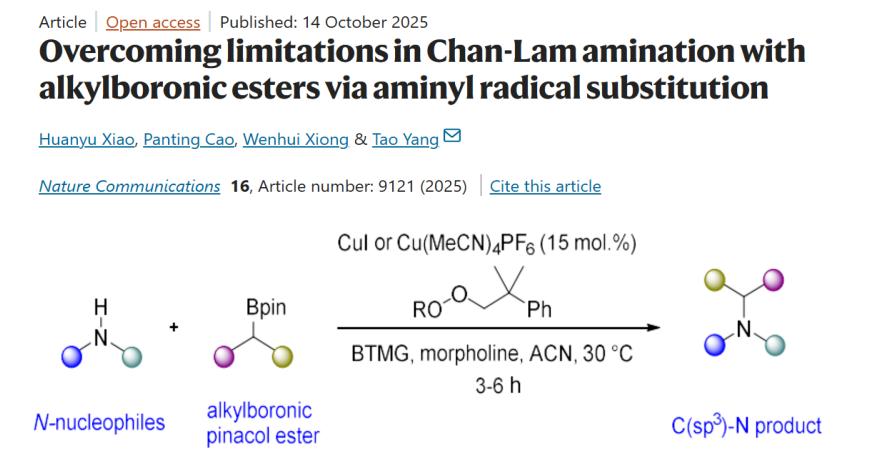
Radical Strategy: Limitations of Chan-Lam Amination of Alkylboronic Esters
Using alkylboronic acid pinacol esters (APEs) as radical precursors, and under Cu(CH₃CN)₄PF₆/CuI (15 mol%) catalysis and BTMG as a base, a silicon-protected cumyl peroxide was used as a bifunctional oxidant to efficiently construct C(sp³)-N bonds between various N-nucleophiles and APEs. This method can be scaled up to 1 gram in scale, effectively overcoming the limitations of traditional Chan-Lam coupling in C(sp³) systems, and is applicable to various alkylboronic acid pinacol esters and N-nucleophiles with different functions. The research results were published in Nat. Commun. (DOI: 10.1038/s41467-025-64155-x).
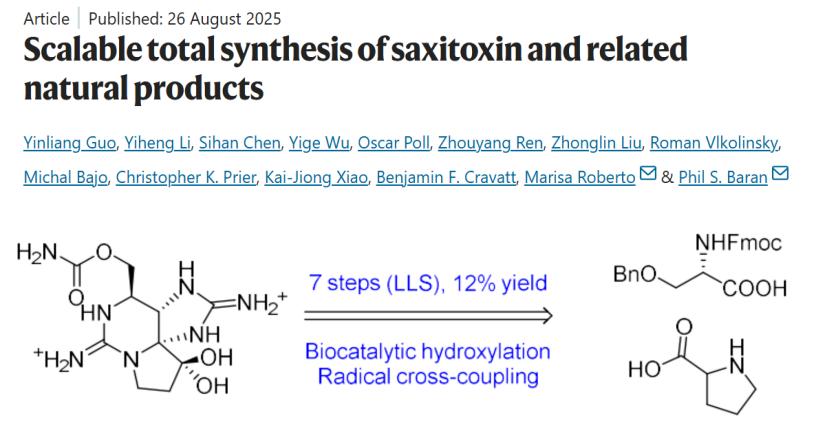
Large-Scale Synthesis: Sciatic Toxins and Related Natural Products
Combining radical retrosynthetic analysis, biocatalysis, and C-H functionalization strategies, a total synthesis of sciatic toxins (STX) was achieved via a 7-step low-level chain reaction (LLS) pathway using serine derivatives and proline as starting materials. The yield reached 12.2%, and the product scale can be scaled up to 10 g. This route represents the first modular and large-scale synthesis of the STX family, far exceeding the efficiency of traditional synthetic routes. It enables the synthesis of various family members based on common intermediates, providing crucial support for the development of natural product drugs. The related research was published in Nature (DOI: 10.1038/s41586-025-09551-5).
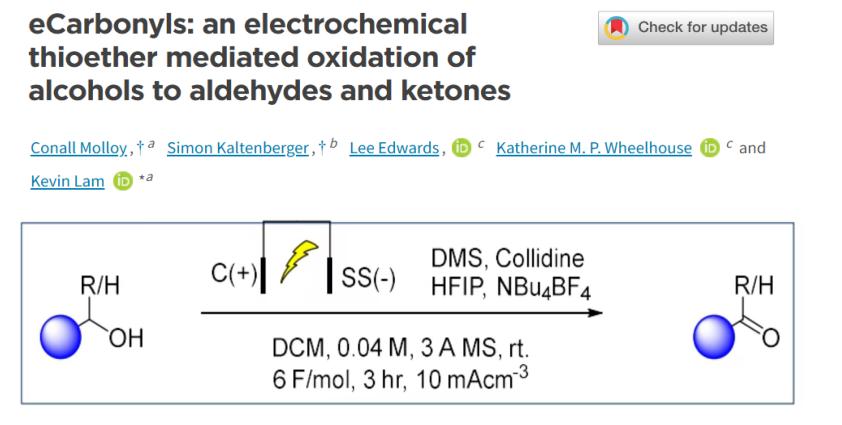
Electrochemical Oxidation New Technology: Mild Conversion of Alcohols to Aldehydes and Ketones
A selective conversion of primary/secondary alcohols to aldehydes/ketones was achieved in a room-temperature, unseparated electrolytic cell using stable thioethers (such as dimethyl sulfide) as the medium. This technique, as an electrochemical alternative to Swern oxidation, enables gram-scale synthesis and flow electrolysis, filling the gap between mildness and scalability in traditional methods. Furthermore, it covers a broad substrate range including sensitive functional groups such as alkenes, sulfides, protected alcohols, and alkyl halides. The research findings were published in Chem. Sci. (DOI: 10.1039/d5sc06546a).
New Tool for Reductive Amination: Facilitating Efficient Synthesis of Marketed Drugs
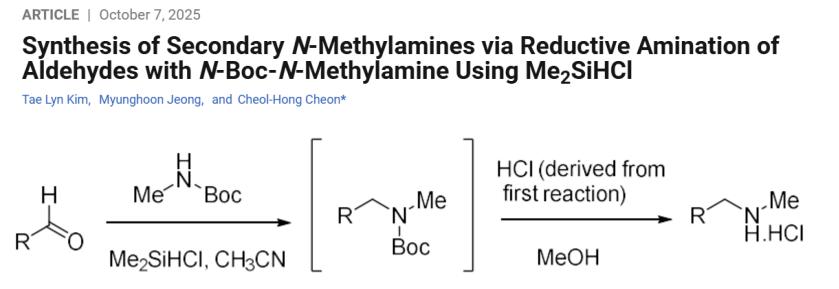
A novel reductive amination reaction using Me₂SiHCl as a reducing agent has been developed, enabling the efficient synthesis of secondary N-methylamines via the reaction of aldehydes with N-Boc-N-methylamines. This method offers a broad substrate scope, encompassing aryl, heteroaryl, and alkyl compounds, with excellent yields (>99%). The products can be purified by filtration/recrystallization, eliminating the need for complex column chromatography. The reaction can be scaled up to 20 mmol and has been successfully applied to the final step synthesis of the marketed drug vonoprazan. The relevant findings were published in J. Org. Chem. (DOI: 10.1021/acs.joc.5c01850).