
The World's First Dual-load ADC hRS7-E+T (KH815) Preclinical Data Released
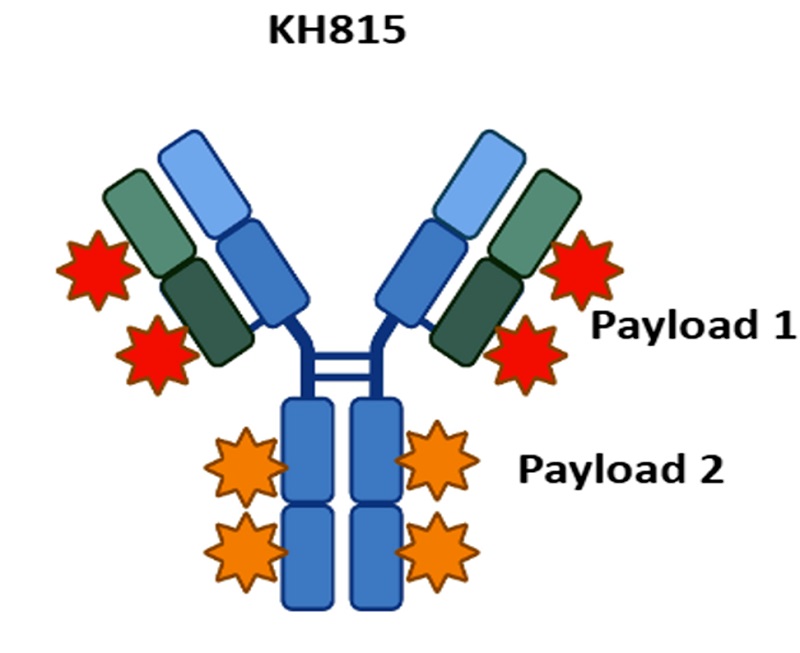
Kanghong Pharmaceutical's jointly developed world's first dual-load TROP2-targeted ADC, hRS7-E+T (KH815), published its preclinical results in 《Molecular Cancer Therapeutics》. Its innovative "one antibody, two toxicities" design releases two payloads sequentially, first overcoming drug resistance and then precisely killing the target. In vitro and in vivo experiments (including drug-resistant models) showed superior activity compared to existing ADCs, with an HNSTD of 50 mg/kg. The drug has received clinical trial approvals in China and Australia and is currently initiating international multi-center clinical trials, providing a new solution for tumor drug resistance.
In October 2025, Chengdu Kanghong Pharmaceutical Group Co., Ltd., in collaboration with the Sichuan Provincial Key Laboratory of Biotechnology Innovation Drug Application and Transformation, officially published detailed preclinical research results of its TROP2-targeting dual-load antibody-drug conjugate (ADC) hRS7-E+T (development code: KH815) in the internationally authoritative journal *Molecular Cancer Therapeutics*. As the world's first dual-toxin ADC to receive clinical approval (approved by the Australian HREC in March 2025 and by China in April 2025), this drug, with its innovative design of "dual-mechanism synergistic killing + precise sequential release," provides a novel solution to the drug resistance problem of traditional single-load ADCs, marking a new stage in my country's ADC drug development towards multi-load synergistic therapy.

1.Innovative Design
The core breakthrough of hRS7-E+T lies in its innovative combination of two complementary cytotoxic payloads—the topoisomerase I inhibitor Exatecan (EXA) and the RNA polymerase II inhibitor Triptolide (TPL)—to a humanized IgG1 antibody (hRS7) targeting TROP2 via differential conjugation technology, forming a precise delivery system of "one antibody, two toxicities".
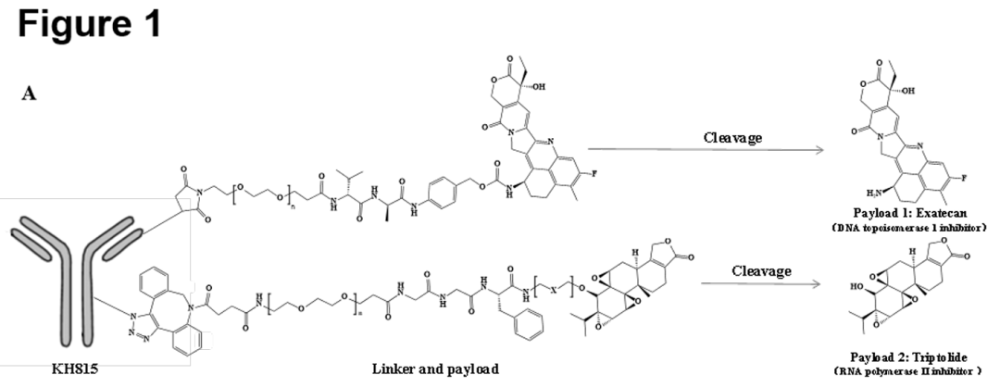
From a molecular design perspective, this drug employs two highly controllable conjugation strategies. Exatecan (EXA) conjugation utilizes a maleimide linker and a dipeptide-cleavable linker to achieve random conjugation of EXA to antibody cysteine residues, with an average of approximately four EXA molecules conjugated per antibody molecule. Tripterygium wilfordii (TPL) conjugation utilizes a tetrapeptide linker containing a DBCO group to directionally conjugate TPL to the modified glycosyl group at the N301 site of the antibody, with an average of approximately four TPL molecules conjugated per antibody molecule.
The final drug-antibody ratio (DAR) remained stable at 8 (4+4), and the drug distribution uniformity was verified by reversed-phase high-performance liquid chromatography (RP-HPLC) and liquid chromatography-mass spectrometry (LC-MS). Size exclusion chromatography (SEC-HPLC) showed a purity of over 95%, along with good thermal stability (Tm1=62.5℃) and a uniform hydrated particle size of approximately 10 nm, laying the foundation for the stability and efficacy of clinical applications.
2.Mechanism of Action
Traditional single-load ADCs are prone to treatment failure due to upregulation of drug resistance proteins (such as P-glycoprotein P-gp and heat shock protein HSP70) or downregulation of target antigens by tumor cells. However, hRS7-E+T constructs a dual pathway of "breaking defense and killing" against tumor drug resistance through a sequential release mechanism of "TPL first, EXA follow-up attack".
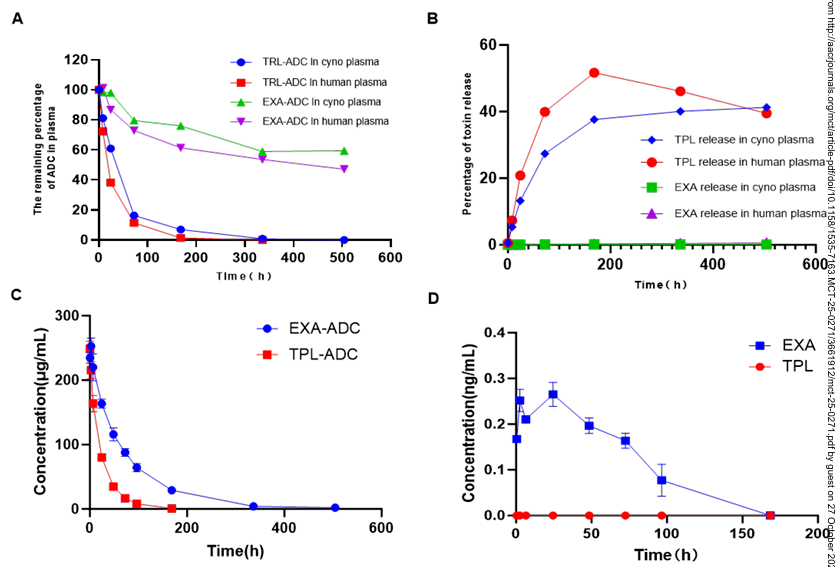
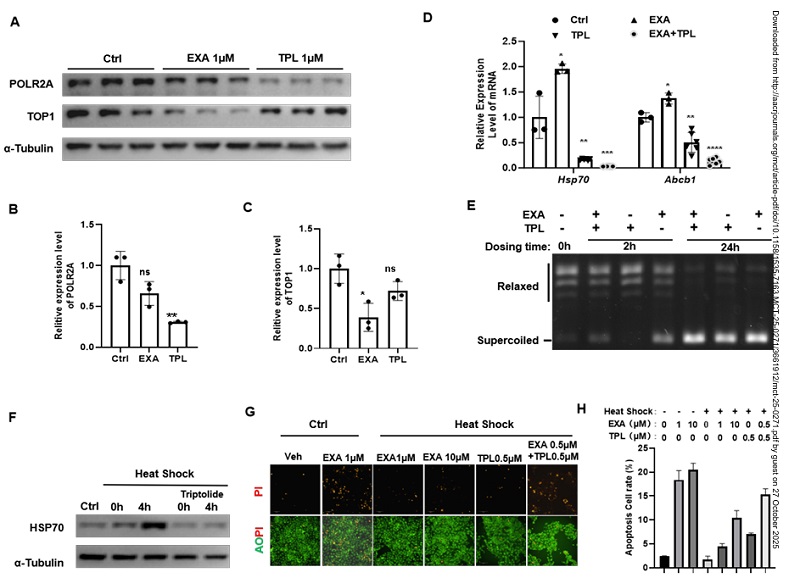
Preclinical studies have confirmed that TPL release is significantly faster than EXA: in human and cynomolgus monkey plasma, TPL release rate exceeds 88% within 72 hours, while 46.45% of EXA remains bound to the antibody even after 504 hours. Early-released TPL can break down tumor resistance through two pathways: firstly, by covalently binding to XPB protein (TFIIH complex subunit) to inhibit RNA polymerase II activity, it significantly downregulates the transcription and expression of HSP70 (heat shock protein 70)—HSP70 is a key protein leading to resistance to topoisomerase I inhibitors such as Exatecan, and its high expression promotes tumor cells to repair DNA damage and evade apoptosis; secondly, TPL can reduce the mRNA level of the drug efflux pump P-gp (encoded by the ABCB1 gene), reducing the probability of EXA being "pumped out" by tumor cells and significantly increasing the sensitivity of tumor cells to subsequent EXA.
EXA, a highly active topoisomerase I inhibitor, is released slowly and has better cell membrane permeability than the clinically commonly used DXd. It can precisely inhibit TOP1, a key enzyme in DNA replication, transcription, and repair, and induce DNA double-strand breaks. In NCI-H292 cell experiments, EXA alone reduced TOP1 protein levels by 40%, while the combined action of hRS7-E+T increased the TOP1 degradation rate to 65%, while significantly reducing the generation of "relaxed DNA" (an indicator of TOP1 activity). The DNA damage effect was 2.3 times greater than that of the single drug within 24 hours.
This synergistic mechanism of "first reversing drug resistance, then precisely killing the target" allows the two payloads to target the RNA transcription and DNA replication processes of tumor cells respectively, forming a "double strike" that avoids the limitations of single-target therapy at the molecular level.
3.Preclinical Efficacy Data
Kanghong Pharmaceutical's team has comprehensively verified the anti-tumor activity of hRS7-E+T in three major systems: in vitro cell experiments, cell line-derived xenograft (CDX) models, and patient-derived xenograft (PDX) models, showing significant advantages, especially in low target expression and drug resistance models.
3.1 In Vitro Experiments
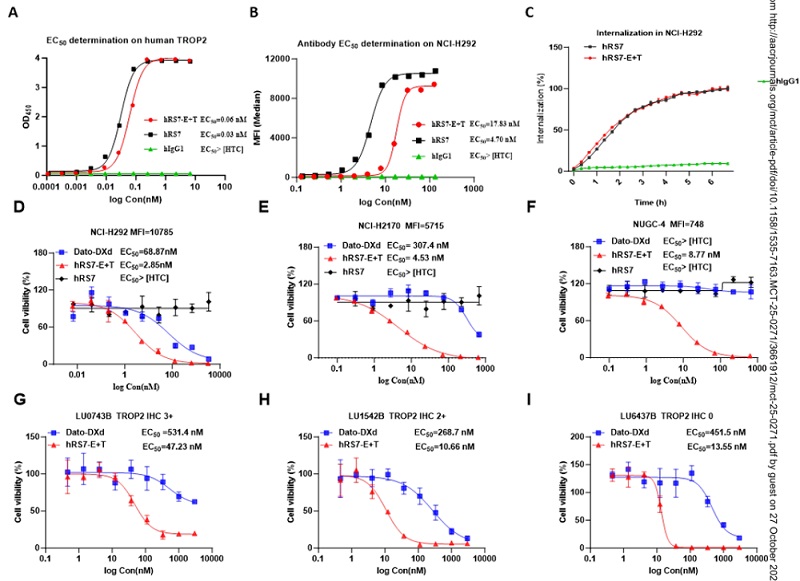
In tumor cell lines with different TROP2 expression levels, hRS7-E+T showed superior killing activity compared to the clinically approved TROP2-targeting ADC Dato-DXd (Datopotamab deruxtecan).
l High expression model (NCI-H292, TROP2 MFI=10785): The EC50 (half-maximal effect concentration) of hRS7-E+T was only 2.85 nM, while that of Dato-DXd was 68.87 nM, representing a more than 24-fold increase in activity.
l Medium expression model (NCI-H2170, TROP2 MFI=5715): The EC50 of hRS7-E+T was 4.53 nM, while that of Dato-DXd was as high as 307.4 nM.
l Low expression model (NUGC-4, TROP2 MFI=748): The activity of Dato-DXd was below the detection limit (EC50>[HTC]), while hRS7-E+T still maintained a strong activity of 8.77 nM.
3.2 In Vivo Models
3.2.1 CDX Model
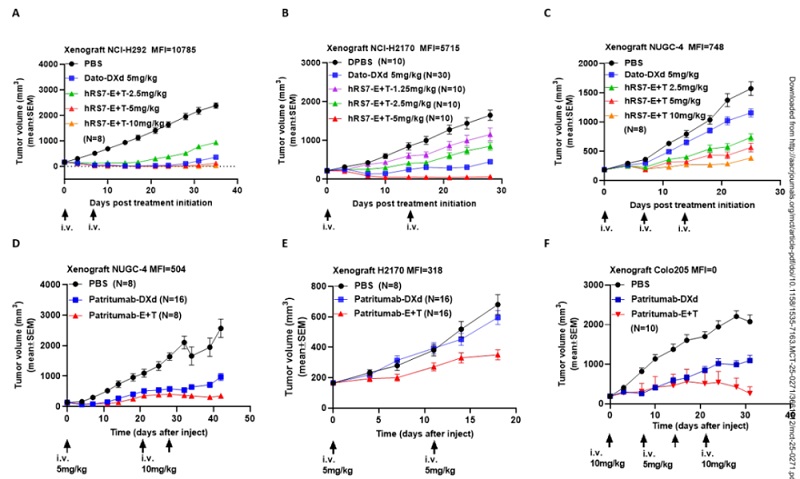
In the NCI-H292 (high-expression) CDX model, hRS7-E+T exhibited significant dose-dependent antitumor effects: In the 10 mg/kg dose group, complete tumor regression (CR) was achieved in all five tumor-bearing mice after 31 days of administration, with a tumor growth inhibition rate (TGI) of 108%. Even in the low-dose group of 2.5 mg/kg, the TGI remained at 69.8%, while the TGI of Dato-DXd (5 mg/kg) at the same dose was only 97.3%, with no cases of complete regression.
In the NUGC-4 (low-expression) CDX model, the TGI of Dato-DXd at 5 mg/kg was only 13.7%, while the TGI of the hRS7-E+T group at 5 mg/kg increased to 78.2%, confirming its therapeutic advantage against tumors with low target expression.
3.2.2 PDX Model
In PDX models that more closely resemble real-world tumor characteristics, the advantages of hRS7-E+T are further highlighted.
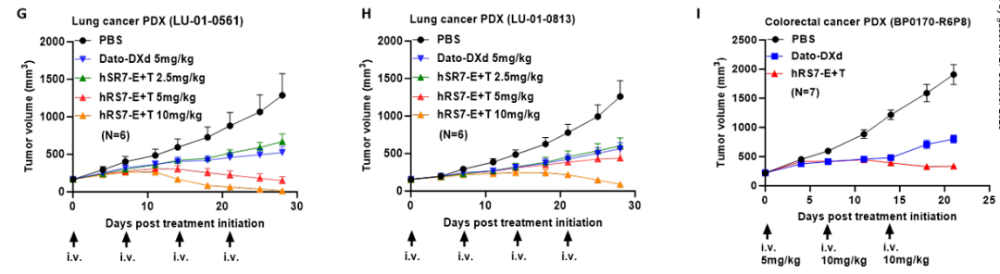
l Lung cancer PDX (LU-01-0561): The TGI of hRS7-E+T at 10 mg/kg reached 113.6%, while the TGI of Dato-DXd at 5 mg/kg was only 68%.
l Colorectal cancer PDX (BP0170-R6P8): In the later stages of treatment, the tumors in the Dato-DXd group showed significant recurrence and growth, while the tumors in the hRS7-E+T group continued to shrink, with a 42% decrease in volume from baseline after 28 days of treatment.
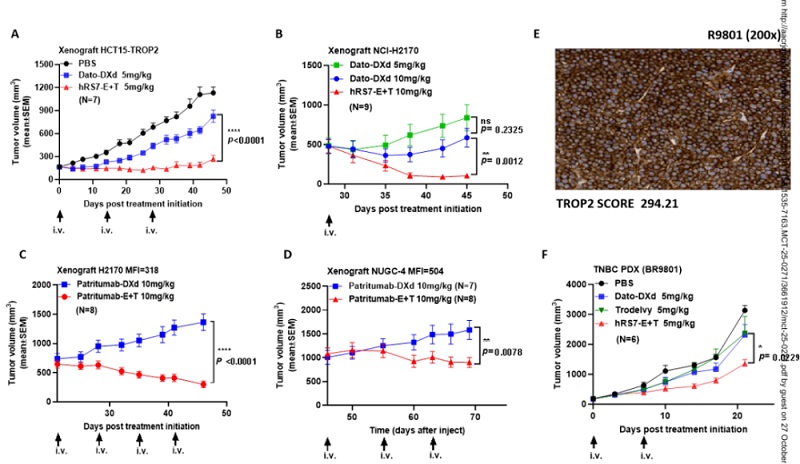
l Breast cancer PDX (BR9801, progressed after Trodelvy treatment): Neither Dato-DXd nor Trodelvy (5 mg/kg) effectively inhibited the tumor (TGI < 40%), while hRS7-E+T at the same dose achieved a TGI of 56.93%, effectively controlling drug-resistant tumors.
3.2.3 Drug Resistance Model
In a CDX model constructed from HCT15-TROP2 cells highly expressing P-gp (multidrug resistance protein), the TGI of Dato-DXd at 5 mg/kg was only 31.4%, showing almost no therapeutic effect; while hRS7-E+T at the same dose achieved a TGI of 89.5%, and tumor-bearing mice showed no significant weight loss, confirming its effectiveness in overcoming P-gp-mediated multidrug resistance.
In the Dato-DXd-resistant NCI-H2170 CDX model, a single administration of 10 mg/kg hRS7-E+T significantly shrunk tumors that had grown to 500 mm³, with a 35% volume reduction after 7 days, while additional Dato-DXd (10 mg/kg) had no significant effect.
4.Safety Assessment
Non-GLP cynomolgus monkey toxicity studies showed that hRS7-E+T has a favorable safety profile: using a dosing regimen of intravenous infusion every 3 weeks for a total of 3 times, the highest non-serious toxic dose (HNSTD) was determined to be 50 mg/kg.
The main toxic reactions observed in the experiments were reversible skin-related reactions (hair loss, increased skin pigmentation, local skin cracking), and transient abnormalities in the hematologic system (mild decrease in granulocytes) and liver function indicators (mild increase in ALT and AST). All of these reactions gradually returned to normal after discontinuation of the drug. No significant effects were observed on body weight, body temperature, blood pressure, electrocardiogram, coagulation function, or immune indicators (lymphocyte subsets, cytokines). Bone marrow smears also showed no abnormalities, confirming that it has no risk of serious immunotoxicity or bone marrow suppression, providing a safe window for clinical dosage exploration.
5.Summary
As the world's first dual-load ADC to enter the clinical stage, hRS7-E+T's preclinical research results have three significant implications: First, it innovatively proposes a "sequential release of dual loads" strategy, overcoming the limitations of traditional single-load ADCs and providing a replicable technical framework for addressing ADC resistance; second, it covers tumors with high, intermediate, and low TROP2 expression, especially showing therapeutic potential for drug-resistant and low-expression patients, potentially expanding the patient pool for ADCs; and third, its good safety profile and stable manufacturing process lay a solid foundation for subsequent clinical research.
Currently, international multicenter clinical trials of hRS7-E+T have been initiated, focusing on evaluating its safety and efficacy in solid tumors (such as lung cancer, breast cancer, and colorectal cancer). A representative from Kanghong Pharmaceutical stated that the development of this drug is not only a significant breakthrough for the company in the ADC field but also promotes the transformation of my country's innovative drugs from "follower" to "leader," potentially providing more precise and effective treatment options for cancer patients worldwide in the future.
Read More
https://aacrjournals.org/mct/article/doi/10.1158/1535-7163.MCT-25-0271/766766/A-Novel-Dual-Payload-ADC-Platform-Integrating