
Aufheben Strategy: Resolving Conflicting Properties in Drug Design
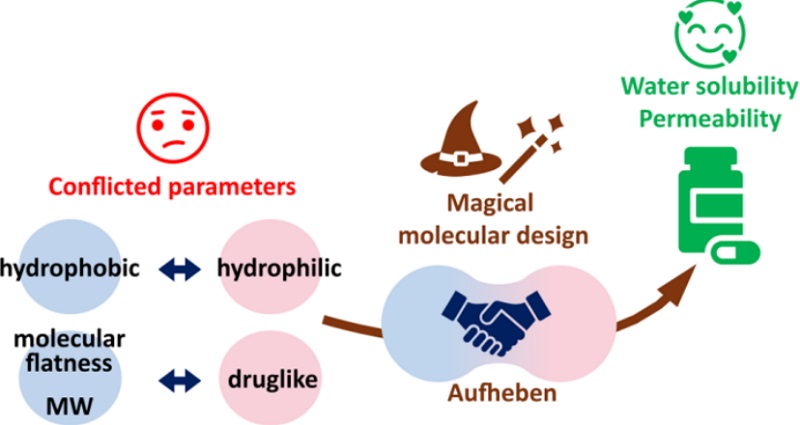
The Aufheben strategy enables balanced drug properties by concurrently preserving active conformations and modifying conflicting characteristics. This approach systematically optimizes both small molecules (via disrupted intermolecular interactions) and bRo5 compounds (including cyclic peptides and PROTACs through conformational regulation), offering transformative solutions beyond conventional druglikeness paradigms and expanding molecular design possibilities.
A central challenge in drug discovery lies in endowing bioactive candidate molecules with "druglike" properties; however, optimizing conflicting physicochemical properties like lipophilicity-hydrophilicity through chemical modifications is exceptionally difficult. This literature introduces the "Aufheben" concept—achieving holistic optimization by concurrently preserving and adjusting seemingly opposing characteristics. It discusses strategies from a molecular design perspective to reconcile contradictory parameters including lipophilicity/hydrophilicity, druglikeness/molecular flatness, and druglikeness/molecular weight. Through precise chemical modifications, it aims to simultaneously "preserve" the molecule's active conformation and "adjust" conflicting physicochemical properties, thereby achieving concurrent improvements in aqueous solubility and membrane permeability.
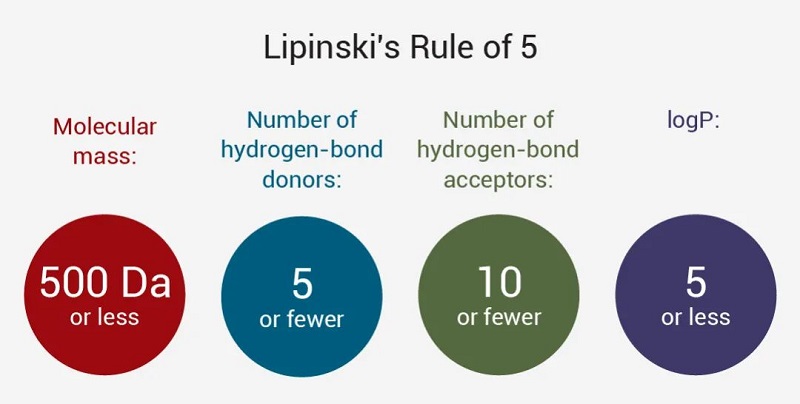
The Rule of Five (Ro5), proposed in 1997 (Molecular Weight ≤ 500, log P ≤ 5, Hydrogen Bond Donors ≤ 5, Hydrogen Bond Acceptors ≤ 10), serves as the classical framework for assessing the oral potential of small-molecule drugs. In recent years, with the development of "undruggable" targets, bRo5 molecules (MW 500-3000, excluding biologics like proteins and antibodies, e.g., cyclic peptides, PROTACs) have gradually become a research hotspot. Due to their larger molecular size, these molecules face higher energy costs for cavity formation (leading to low aqueous solubility) and greater steric resistance during membrane penetration (resulting in poor permeability). Their inherent physicochemical conflicts are more pronounced, presenting unique challenges in achieving a balance between aqueous solubility and membrane permeability.
I. The Solution for Small-Molecule Drugs: Disrupting Intermolecular Interactions
The aqueous solubility of a compound is influenced by the packing mode of its molecules in the solid state. Therefore, disrupting the tight crystalline packing structure between molecules can effectively enhance water solubility. For traditional small molecules (MW ≤ 500), the root cause of conflicting physicochemical properties often lies in excessive intermolecular stacking. Planar structures tend to form tightly packed crystals, while strong hydrogen bonds can create significant resistance to dissolution. The key to the Aufheben strategy is to "break this packing" through chemical modifications while preserving the molecule's ability to bind to its target.
1. Disrupting Molecular Planarity: From "Paper-Thin" to "Three-Dimensional Structure"
Planar molecules (e.g., polyaromatic compounds) are prone to π-π stacking, leading to the formation of tightly packed crystal structures, which directly results in very low solubility. To address this issue, introducing substituents to increase the three-dimensionality (i.e., "thickness") of the molecule is an effective strategy for reducing crystal packing energy.
l Ortho-Substitution of Biaryl Groups
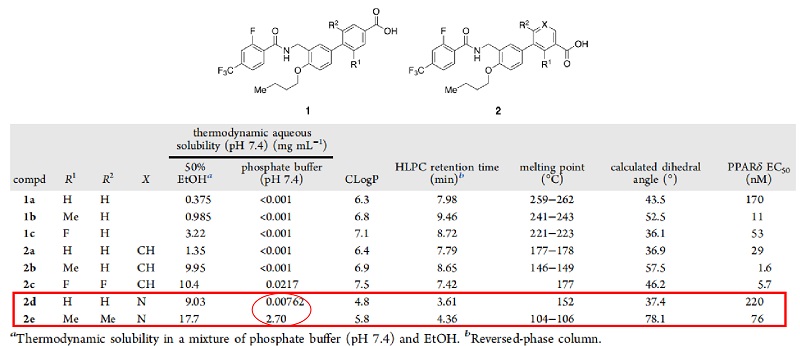
Introducing groups such as methyl or fluorine at the ortho positions of a biphenyl structure increases the dihedral angle (the angle between molecular planes). For example, a specific PPARδ agonist, through ortho-dimethyl substitution compared to the unsubstituted compound 2d, saw its solubility in pH 7.4 buffer increase from 0.00762 mg/mL to 2.70 mg/mL (a 350-fold improvement), its melting point decrease from 152°C to 104-106°C, and its PPARδ agonist activity improve from 220 nM to 76 nM.
l Benzyl α-Methylation
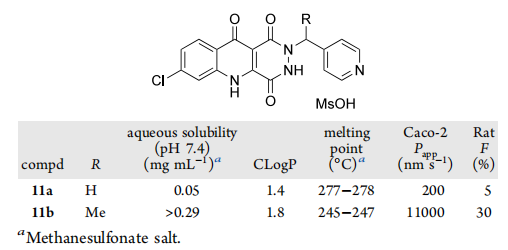
Introduction of a methyl group at the α-position of a benzyl moiety disrupts molecular coplanarity. For instance, in the case of an NMDA receptor antagonist, α-methylation (compound 11a → 11b) increased aqueous solubility from 0.05 mg/mL to >0.29 mg/mL (a≥5.8-fold improvement), elevated oral bioavailability from 5% to 30%, and dramatically enhanced Caco-2 membrane permeability from 200 nm/s to 11,000 nm/s.

2. Reducing Structural Flatness: Increasing Fsp³ to Enhance "Three-Dimensional Character"
Fsp³(the fraction of sp³-hybridized carbon atoms relative to total carbon atoms, i.e., molecular saturation) is a key metric for assessing a molecule's "three-dimensional character." Fsp³ is positively correlated with solubility and negatively correlated with melting point. Generally, a higher Fsp³value indicates a less planar molecule, which often leads to improved solubility and permeability.
l Partial Saturation of Aromatic Rings
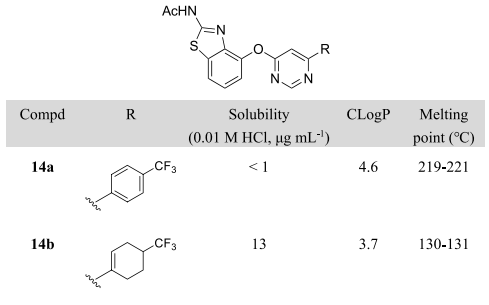
Converting aromatic rings like benzene into saturated or partially saturated ring systems (e.g., cyclohexane, tetrahydropyran) increases the proportion of sp³carbon atoms. For instance, in the case of a specific vanilloid receptor-1 (TRPV1) antagonist, partial saturation of the 4-trifluoromethylphenyl ring (compound 14a → 14b) increased solubility from <1 µg/mL (in 0.01M HCl) to 13 µg/mL (a ≥ 13-fold improvement) and lowered the melting point from 219-221 °C to 130-131 °C.

l Bioisosteric Replacement of Benzene Rings
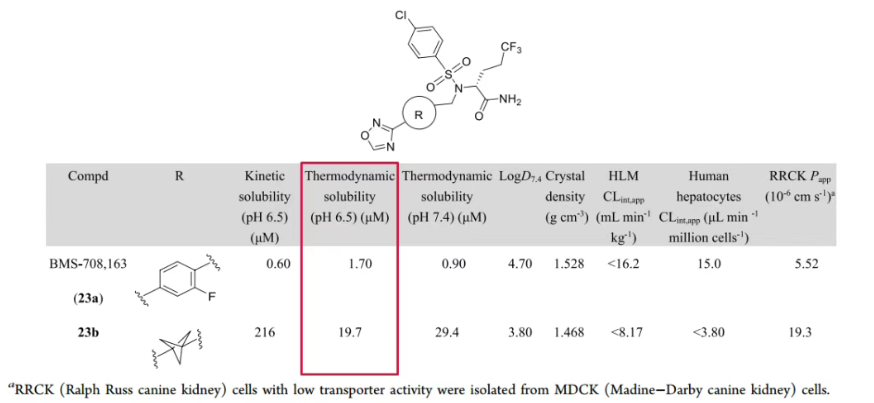
Replacement of benzene rings with rigid, sp³-hybridized ring systems (e.g., BCP (bicyclo[1.1.1]pentane), BCO (bicyclo[2.2.2]octane)) optimizes physicochemical properties while retaining target binding affinity. For example, in a γ-secretase inhibitor, substituting a fluorobenzene ring with BCP resulted in an 11.6-fold increase in thermodynamic solubility at pH 6.5, enhanced Caco-2 permeability from 5.52×10⁻⁶ cm/s to 19.3×10⁻⁶ cm/s, and achieved 100% oral bioavailability in rats.

3. Modulating Hydrogen Bonding: Reducing "Intermolecular Cohesion" and Enhancing "Intramolecular Stability"
Hydrogen bonds serve as key linkages in molecular packing. Precise modulation of hydrogen bonding can simultaneously optimize both solubility and permeability.
l Reducing Intermolecular Hydrogen Bonds
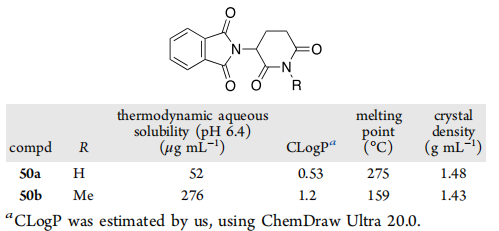
Removing solvent-exposed hydrogen bond donors/acceptors decreases crystal packing strength. For example, in thalidomide, N-methylation (compound 50b) removes one hydrogen bond donor, increasing solubility from 52 µg/mL to 276 µg/mL (a 5.3-fold improvement) and lowering the melting point from 275 °C to 159 °C.
l Introducing Intramolecular Hydrogen Bonds
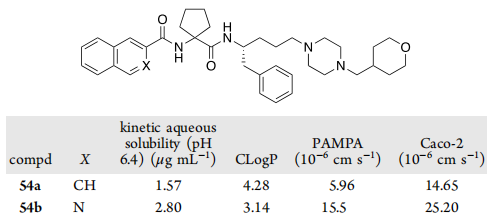
Forming intramolecular hydrogen bonds can lock the active conformation while reducing exposed polar groups, thereby enhancing permeability. For instance, in a neurokinin receptor antagonist, introducing a nitrogen atom adjacent to the naphthamide moiety creates an intramolecular hydrogen bond. Compared to compound 54a, compound 54b exhibited increased aqueous solubility (from 1.57 µg/mL to 2.80 µg/mL) and higher Caco-2 permeability (from 14.65×10⁻⁶ cm/s to 25.20×10⁻⁶ cm/s).
II. Specialized Solutions for bRo5 Molecules: From "Conformational Control" to "Linker Optimization"
For bRo5 molecules (e.g., cyclic peptides, PROTACs), their large molecular weight leads to high energy costs for cavity formation during dissolution and significant steric hindrance during membrane permeation, rendering conventional small-molecule optimization strategies ineffective. Consequently, the core of the Aufheben strategy shifts from static structural modification to leveraging conformational flexibility and environmental responsiveness, enabling molecules to dynamically "switch forms" to adapt to different environments.
1. Cyclic Peptides
Cyclic peptides, rich in amide bonds (highly polar and prone to hydrolysis), often exhibit poor permeability. Significant improvements in balancing permeability and stability can be achieved through N-methylation and ester bond modifications.
l Precise N-Methylation
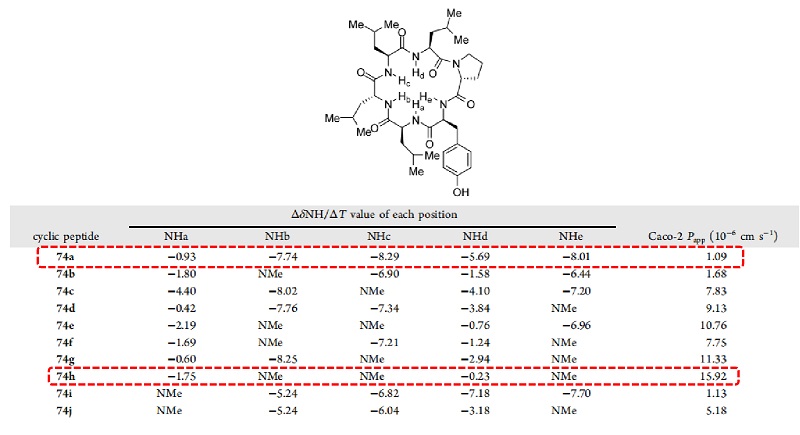
Selective methylation of "solvent-exposed amide NH" groups (identified by NMR temperature coefficients, ΔδNH/ΔT < -4.6 ppb/K) reduces the exposure of polar groups. For example, a specific cyclic hexapeptide showed an increase in Caco-2 permeability from 1.09×10⁻⁶ cm/s to 15.92×10⁻⁶ cm/s after multi-site N-methylation, achieving an oral bioavailability of 33%.
l Amide-to-Ester Substitution
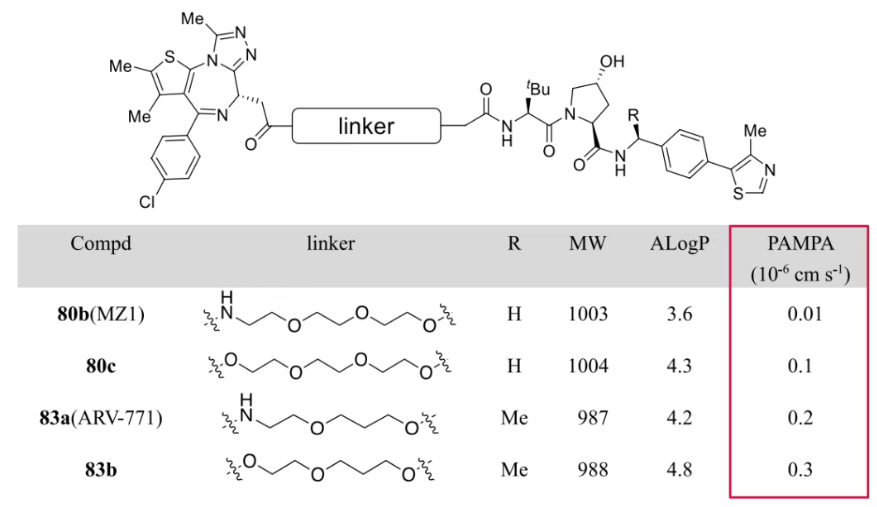
Replacing some amide bonds with ester bonds reduces polarity while maintaining conformational stability. Studies found that cyclic peptides modified with ester bonds showed 2-3 times higher PAMPA permeability than their N-methylated analogs and demonstrated more significant improvement in metabolic stability in mice.
2. PROTACs
PROTACs (proteolysis-targeting chimeras) are typical bRo5 molecules (MW: 800-1200) composed of a "target ligand-linker-E3 ligase ligand" structure. Their core challenge is the "low solubility and high efflux ratio resulting from large molecular size." The Aufheben strategy offers breakthroughs primarily through the following aspects:
l Balancing Linker Flexibility and Rigidity
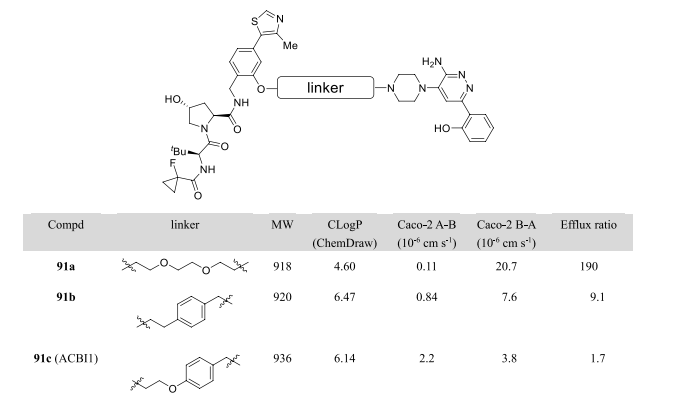
The linker must be sufficiently flexible to facilitate ternary complex formation, yet avoid excessive flexibility that leads to polar group exposure. For instance, in a BRD4 PROTAC, replacing an ethylene glycol (highly flexible) linker with a 4-oxyethoxybenzyl (balanced rigidity-flexibility) linker reduced the efflux ratio from 190 to 1.7 and increased Caco-2 permeability from 0.11×10⁻⁶ cm/s to 2.2×10⁻⁶ cm/s.
l Molecular Chameleonicity
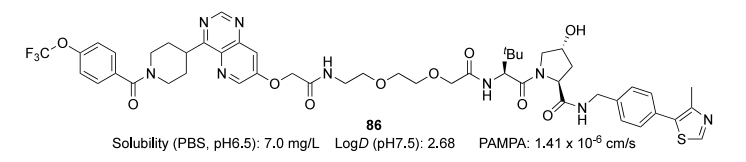
PROTACs can adjust their conformation based on the environment: in aqueous environments like the gastrointestinal tract, they adopt an "open conformation," exposing polar groups to enhance solubility; in lipophilic environments like cell membranes, they switch to a "closed conformation," shielding polar groups via intramolecular hydrogen bonding to improve membrane permeability. For example, a specific VHL-PROTAC showed a 30% higher proportion of the closed conformation in chloroform (simulating a membrane environment) compared to in a DMSO-water mixture (simulating bodily fluids), accompanied by a 25% reduction in its 3D polar surface area.
Summary
This review elucidates the core value of the Aufheben strategy in druglikeness optimization, with key conclusions as follows:
Ⅰ. Strategic Core: The strategy is broadly applicable across different molecule types. For small molecules, it balances lipophilicity and aqueous solubility by "disrupting intermolecular interactions" (e.g., reducing planarity, interfering with hydrogen bonding, breaking symmetry). For bRo5 macrocycles, it reconciles molecular weight with druglikeness through "conformational control" (e.g., leveraging chameleonicity, introducing N-methylation, optimizing linkers).
Ⅱ. Theoretical Innovation: The strategy represents a paradigm shift from "like dissolves like" to "dynamic adaptation." It validates the feasibility of counterintuitive concepts, such as "using hydrophobic groups to enhance solubility" and "large molecules crossing membranes via conformational rearrangement," significantly expanding the conceptual boundaries of molecular design.
Ⅲ. Future Direction: This strategy is crucial for tackling "undruggable" targets and advancing novel modalities like PROTACs and cyclic peptides. Future research should focus on integrating AI-driven conformational prediction with the development of novel bioisosteres to enhance the precision and predictability of the strategy.
Read More
https://pubs.acs.org/doi/10.1021/acs.jmedchem.5c00287