
ADC Cytotoxins: The Selection Logic of Precision Anti-Cancer "Warheads"
Antibody-drug conjugates (ADCs), often referred to as "biological missiles" in precision cancer treatment, rely heavily on their "warheads"—small molecule cytotoxins—to determine their tumor-killing efficacy. This article systematically analyzes the core selection criteria for ADC cytotoxins, details the mechanisms of action, structural characteristics, and clinical applications of microtubule inhibitors and DNA damaging agents (two major types), provides a comprehensive overview of the ADC pipeline's cytotoxin coverage, compares the IC50 (half-maximum inhibitory concentration) activity differences of common toxins, and highlights the current challenges of limited toxin variety and singular mechanisms of action, offering crucial insights for ADC drug development.
Small molecule cytotoxins, acting as the "warhead" of antibody-drug conjugates (ADCs), are a key component in their killing of tumor cells. While numerous toxins from natural products and chemical synthesis exist, not all toxins can serve as ADC "warheads"; three key conditions must be met simultaneously. First, they must possess extremely high killing efficacy: after entering the body, the dose reaching each gram of tumor tissue is only 0.0003%–0.08% due to factors such as antibody tumor penetration, antigen expression levels, and internalization efficiency. Therefore, the toxin must kill tumor cells at picomolar or nanomolar concentrations. Second, their mechanism of action must be clearly defined: most ADCs are designed to "release toxins after internalization," so the toxin target must be located intracellularly to ensure precise targeting of key pathways in cancer cells after release. Third, they must possess suitable physicochemical properties: small molecular weight to reduce immunogenicity, appropriate water solubility for antibody conjugation, and sufficient stability in plasma to match the long circulating half-life of the ADC.
Early ADCs used conventional chemotherapy drugs such as methotrexate and doxorubicin as toxins, but their insufficient activity led to unsatisfactory clinical results. Today, novel toxins with inhibitory activity 100 to 1000 times higher than traditional chemotherapy drugs have become the mainstream choice for ADC development, mainly divided into two categories: microtubule inhibitors and DNA damaging agents.
1. Tubulin Inhibitors
Microtubule inhibitors, by interfering with cell mitosis and inhibiting tumor cell proliferation, are currently the most widely used type of toxin in the ADC field. They mainly include auristatin and maytansine compounds.
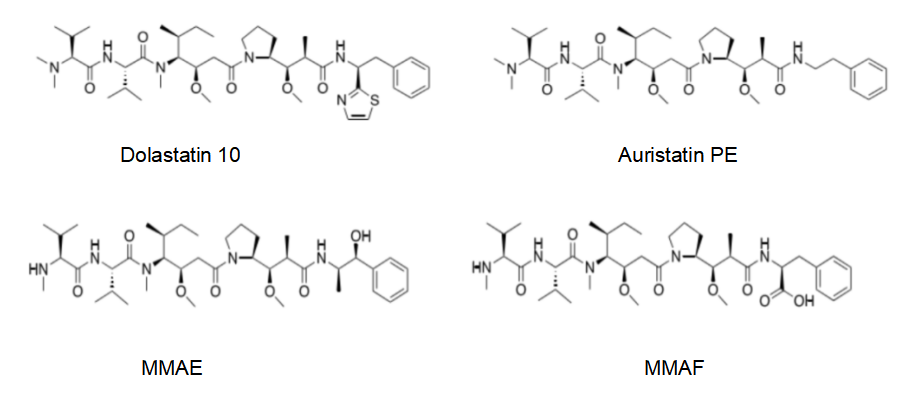
1.1 Auristatin Compounds
Auristatin compounds originated from "sea hare toxin," isolated from Indian Ocean sea hares in the 1960s-1980s. Its mechanism of action involves binding firmly to tubulin, inhibiting microtubule formation and polymerization, hindering the hydrolysis of guanosine triphosphate, and ultimately leading to apoptosis. Early sea hare toxin 10 was discontinued in Phase II clinical trials due to severe side effects such as neutropenia and peripheral neuropathy. Based on this, scientists developed water-soluble analogs—auristatin toxins—with core members including auristatin PE, MMAE and MMAF.
Currently, the most representative ADC using auristatin toxins is the marketed Brentuximab Vedotin (brand name, Adcetris), and more than half of ADCs under clinical development use this class of toxins.
1.2 Maytansine Compounds
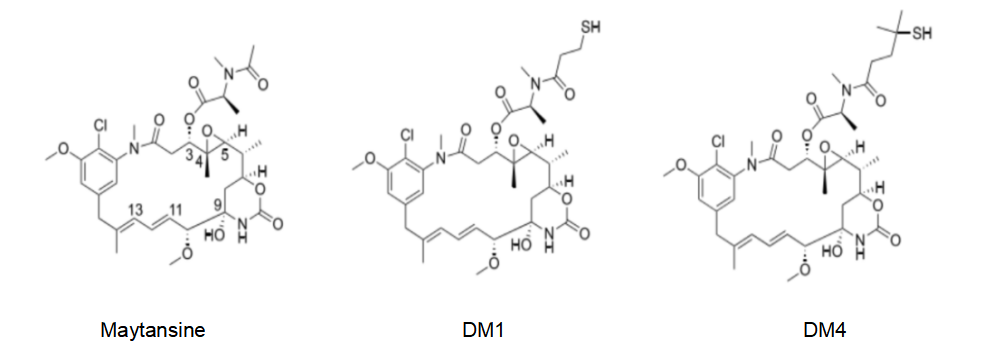
Maytansine was isolated from the bark of an Ethiopian shrub in 1972. It has a 19-membered macrocyclic lactam structure and can inhibit cancer cell proliferation at sub-nanomolar concentrations (ED50 value 10⁻⁵~10⁻⁴ μg·mL⁻¹), exhibiting 1000 times higher inhibitory activity than doxorubicin. Early use was withdrawn from clinical trials due to side effects such as nausea and neurotoxicity caused by a lack of specificity, resulting in a low therapeutic index. After the emergence of the ADC (anti-cancer drug) concept, its high toxicity met the "warhead" requirement, and it became a focus of research again after structural modification.
The C-9 hydroxyl group and the C-11/C-13 double bond of maytansine are essential functional groups. Derivatives can only be generated through modification of the C-3 ester side chain, with DM1 and DM4 being the core members. Their mechanism of action is similar to that of vinblastine, binding to the tubulin-vinca alkaloid binding site, arresting cells in the G2/M phase, and inducing apoptosis.
Currently, the representative marketed ADC using maytansine as a toxin is Trastuzumab Emtansine (trade name Kadcyla), whose toxin is DM1; the pipeline under development includes Mirvetuximab Soravtansine (IMGN853) for the treatment of FOLR1+ ovarian cancer.
2. DNA Damaging Agents
Unlike microtubule inhibitors, which only act on tumor cells in the mitotic phase, DNA damaging agents can act throughout the cell cycle, exhibiting killing effects on resting cells and drug-resistant cells. This has become a core direction for third-generation ADC toxins, mainly including camptothecin derivatives, calicheamicin derivatives, and anthramycin derivatives of PBD.
2.1 Camptothecin Derivatives
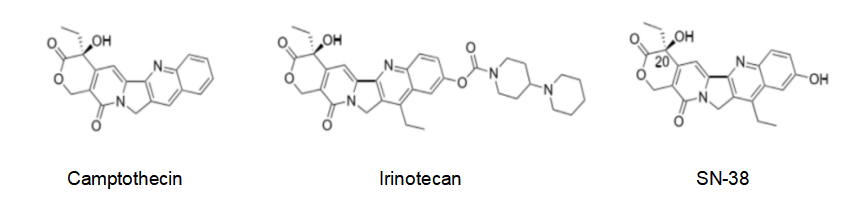
Camptothecin, isolated from the Chinese endemic plant *Camptotheca acuminata*, is a pentacyclic alkaloid. It stabilizes the DNA-topoisomerase I (TopoI) complex, preventing the rejoining of broken DNA strands, inhibiting DNA replication and transcription, and inducing apoptosis. However, due to poor water solubility and the easy opening of the lactone ring, its bioavailability is low, limiting its clinical application. Through structural modification, two core members of the camptothecin family have been derived: irinotecan and SN-38.
2.2 Calicheamicin Compounds
Calicheamicins were isolated in the 1980s from the fermentation products of rare actinomycetes. They belong to the enediyne class of compounds, with a bicyclic [7,3,1] tridecylenediyne core, a methyl trisulfide group, and an aryl tetrasaccharide chain. Their mechanism of action is as follows: the aryl tetrasaccharide chain guides the toxin into the TCCT-AGGA site of the DNA minor groove. The enediyne structure undergoes a Bergman reaction to generate an active phenyl diradical, which abstracts the H atom from the DNA deoxyribose backbone, leading to double-strand breakage.
Calicheamicin γ1I is the most cytotoxic member of this class (a dose of 0.15 μg·kg⁻¹ can kill tumor cells), but its therapeutic window is narrow, preventing direct clinical application. After structural modification (acetylation of ethylaminoglycosides, conversion of trisulfide bonds to disulfide bonds), N-acetyl-γ1I calicheamicin was derived, becoming a classic toxin in ADCs (anti-addictive drug).
Currently, the representative marketed ADCs with N-acetyl-γ1I as the toxin are Gemtuzumab Ozogamicin (trade name Mylotarg) and Inotuzumab Ozogamicin (trade name Besponsa).
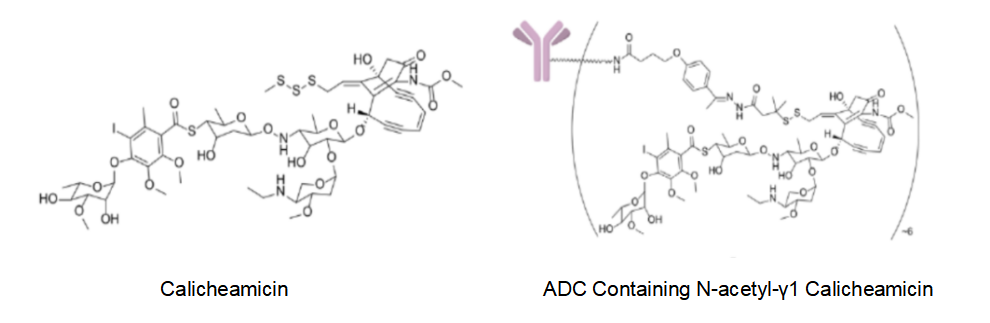
2.3 Anthramycin Derivatives (PBD)
Anthramycin was isolated from Streptomyces in the 1860s. Its analogues, the pyrrolobenzodiazepine (PBD) family, consist of an aromatic ring, a diazepine ring, and a pyrrole ring. A covalent bond is formed between the imine group at the N-10/C-11 position of the diazepine ring and the amino group at the C-2 position of guanine in the minor groove of DNA, fixing the DNA helical structure and blocking cell division.
Studies have found that PBD dimers (such as DSB-120 and SJG-136) have a larger interaction area with DNA through the C-8 link, forming two covalent bonds, significantly enhancing cytotoxicity (effective concentrations reaching picomolar levels), and are effective against MDR tumor cells. Since 2013, PBD has become an emerging ADC toxin, second only to auristatins and maytansine, with more than 10 related ADCs currently in clinical trials.

3. Clinical Overview of ADC Toxins
An analysis of over 500 ADCs already on the market and in development globally reveals that more than 130 types of toxins have been disclosed. The distribution of toxins and the number of pipelines at each clinical stage are as follows.
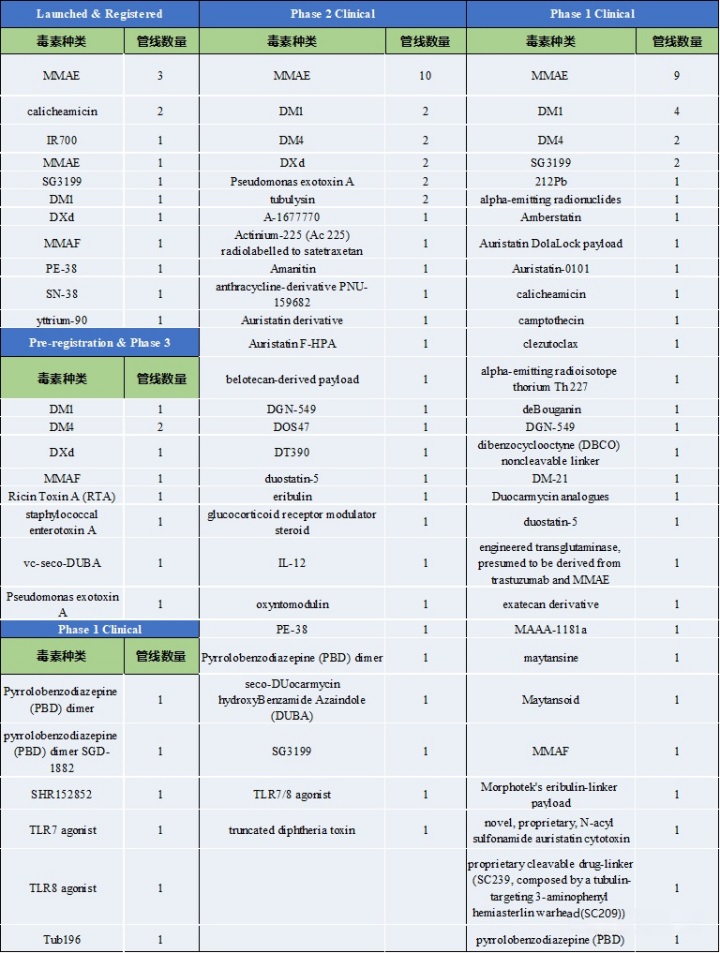
Note. From “The Panoramic Layout of ADC Drug Toxin and Linker” (2022.2)
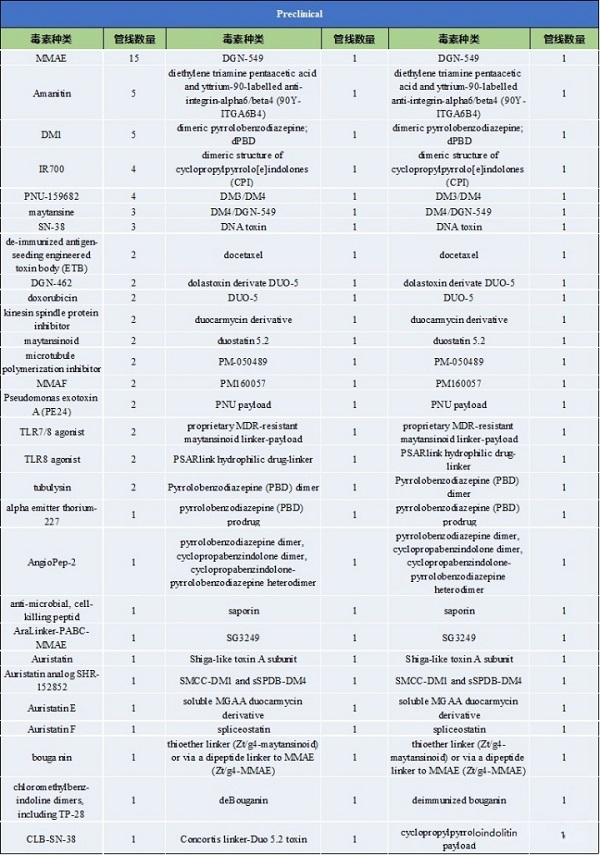
Note. From “The Panoramic Layout of ADC Drug Toxin and Linker” (2022.2)
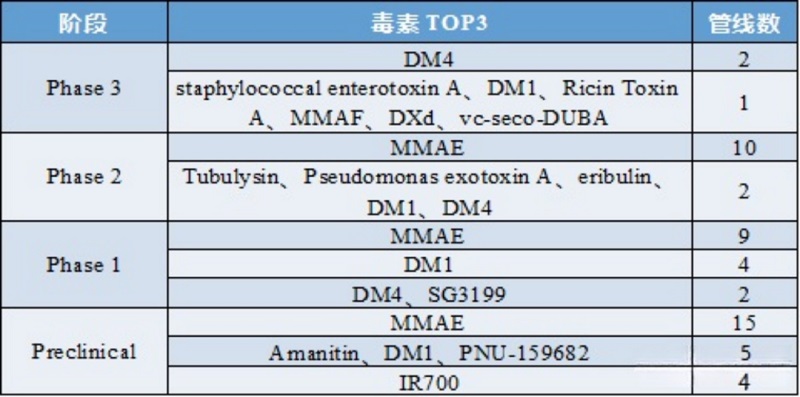
Note. From “The Panoramic Layout of ADC Drug Toxin and Linker” (2022.2)
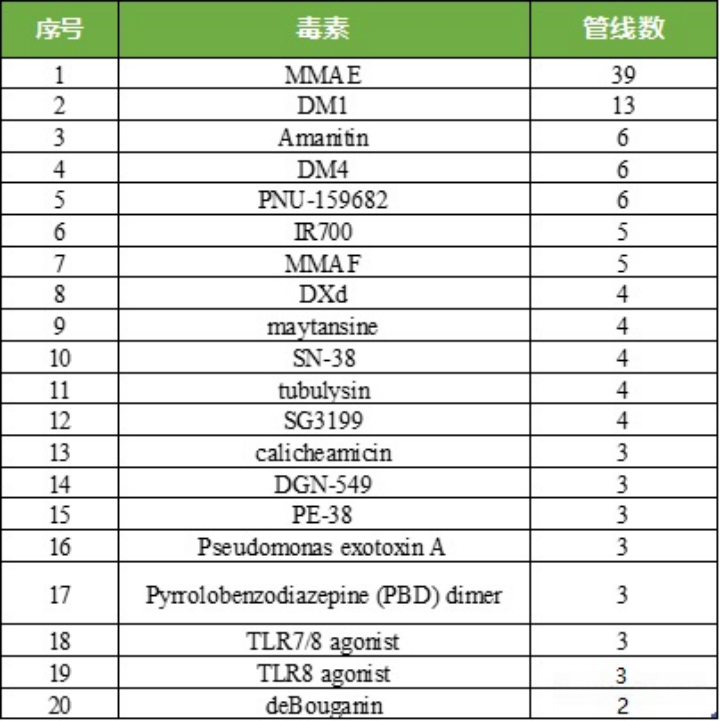
Note. From “The Panoramic Layout of ADC Drug Toxin and Linker” (2022.2)
4. Comparison of IC50 Activity of Common ADC Toxins
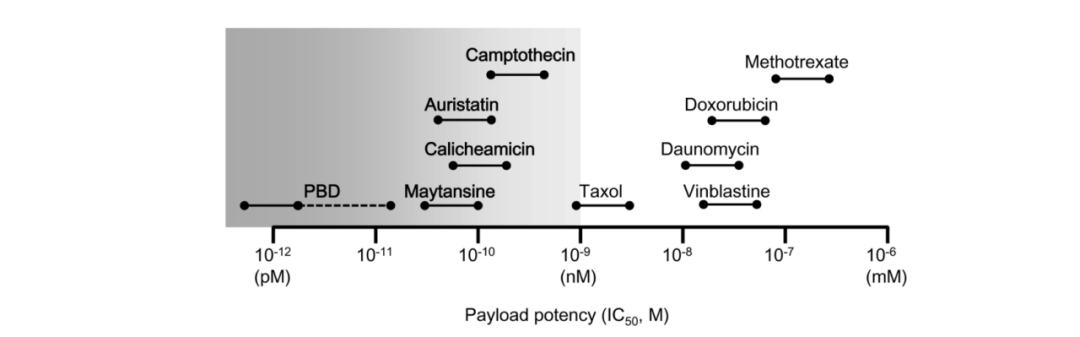
IC50 (half-maximal inhibitory concentration) is a core indicator for measuring toxin activity; the lower the IC50 value, the stronger the toxin's killing efficacy. Analysis shows significant differences in IC50 among different types of ADC toxins. The IC50 of microtubule inhibitors (such as MMAE and DM1) is mostly in the nanomolar range (0.05–1 nM); the IC50 of DNA damaging agents (such as calicheamicin and PBD dimer) can reach the picomolar range (0.1–10 pM), exhibiting activity 1–2 orders of magnitude higher than microtubule inhibitors. Furthermore, they can function independently of the cell cycle, making them suitable for tumors with low antigen expression levels. The IC50 values of common toxins are shown in the figure below.
5. Summary
Currently, the field of ADC cytotoxins still faces two major challenges: first, the variety of cytotoxins is limited and their mechanisms of action are singular, with most pipelines relying on microtubule inhibitors and DNA damaging agents; second, they are ineffective against resting tumor cells, as microtubule inhibitors such as MMAE and DM1 only act on cells in the dividing phase, easily leading to insufficient therapeutic efficacy and drug resistance.
Industry experts point out that developing toxins with novel mechanisms of action is a key direction for overcoming existing bottlenecks. In the future, with in-depth research into tumor cell signaling pathways and DNA repair mechanisms, more ADC "warheads" targeting novel sites, covering the entire cell cycle, and overcoming drug resistance will emerge, providing core support for the precise and efficient development of ADC drugs.