
Sevabertinib: A Reversible EGFR-HER2 Inhibitor as a Game-Changer for HER2-Mutant Lung Cancer
Sevabertinib, a novel reversible HER2-EGFR inhibitor, demonstrated remarkable efficacy in the Phase I/II SOHO-01 study. The objective response rate (ORR) was 64% in pretreated patients and as high as 71% in treatment-naïve patients, with activity also observed in those with brain metastases. With its unique mechanism of action and excellent selectivity, Sevabertinib is poised to reshape the treatment landscape for HER2-mutant non-small cell lung cancer (NSCLC). The Phase III confirmatory study, SOHO-02, has now been officially initiated.
In the field of precision therapy for non-small cell lung cancer (NSCLC), HER2 mutations have long presented a clinical challenge of "having a clear target but lacking effective treatments." This mutation type accounts for approximately 2%-4% of NSCLC patients. Traditional chemotherapy regimens show limited efficacy against it, while early-generation pan-HER tyrosine kinase inhibitors (TKIs) achieved an objective response rate (ORR) of only 8%-30%, falling far short of clinical needs.
According to a groundbreaking study recently published in the New England Journal of Medicine (NEJM), the novel drug Sevabertinib (BAY 2927088) demonstrated outstanding efficacy in the Phase I/II clinical trial (SOHO-01) for treating HER2-mutant NSCLC:
1. In Cohort D (81 patients previously treated but not with HER2-targeted therapy):
l The Objective Response Rate (ORR) reached 64%, indicating nearly two-thirds of patients achieved significant tumor shrinkage or complete disappearance.
l The Partial Response (PR) rate was 62%, suggesting most patients derived significant clinical benefit.
l The Complete Response (CR) rate was 2%, reflecting ideal therapeutic outcomes in individual patients.
l The Disease Control Rate (DCR) remained high at 81%.
2. In Cohort E (55 patients previously treated with HER2 Antibody-Drug Conjugates):
The ORR was 38%, PR was 33%, CR was 5%, and DCR reached 71%, indicating significant antitumor activity even in this pre-treated population.
3. In Cohort F (73 treatment-naïve patients):
The ORR was as high as 71%, PR was 67%, CR was 4%, and the DCR reached 89%, demonstrating exceptional potential for first-line treatment.
Of particular note, 22%, 27%, and 12% of patients in Cohorts D, E, and F, respectively, had brain metastases. In-depth analysis revealed that the degree of treatment benefit was largely comparable regardless of the presence of brain metastases, a finding of significant importance for clinical practice.
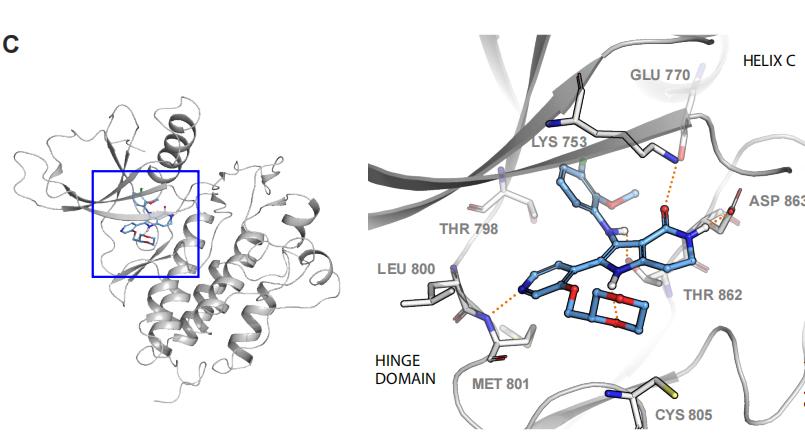
As shown in the figure above, Sevabertinib exhibits distinct interactions with the HER2 protein. These include hydrogen bonding between the pyridine N and the NH of Met801; hydrogen bonds formed by the lactam with Lys753 and Asp863, and a salt bridge with Glu770; and a hydrogen bond between the aromatic amine NH and Thr862, among others. These interactions contribute to the potent inhibitory binding of Sevabertinib.
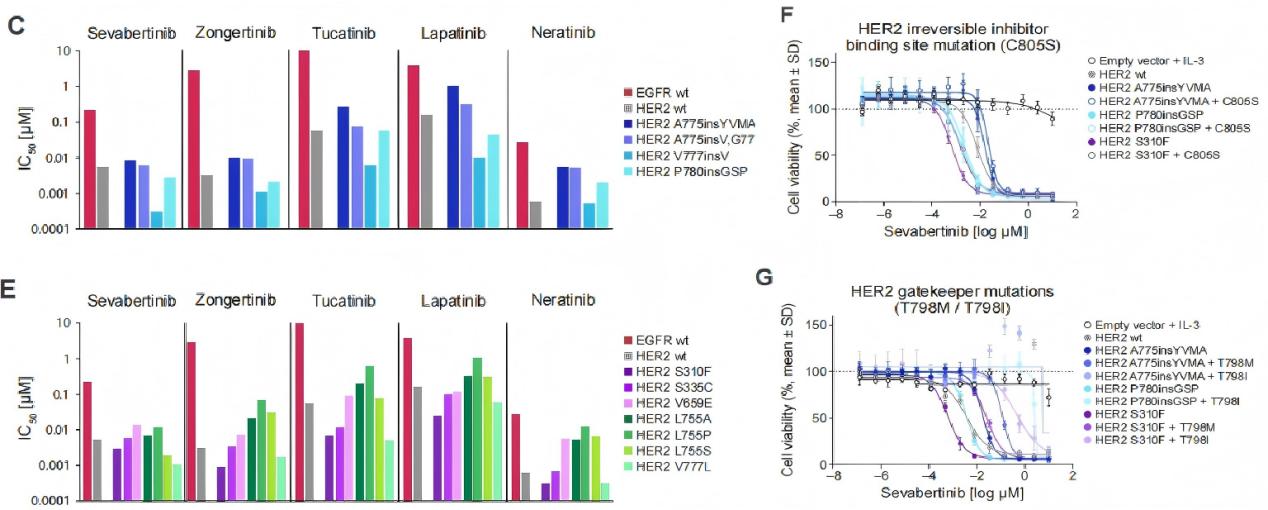
In selectivity assessments against EGFR wild-type (EGFRwt) and other protein kinases, Sevabertinib demonstrated exceptional specificity. Under conditions of 10 μM ATP concentration, 1 μM Sevabertinib inhibited only 18 out of 373 kinases by more than 80%. At physiologically relevant ATP concentrations (2 mM), the compound showed significant inhibitory activity only against DDR2 (IC50 = 53.3 nM), with a selectivity index exceeding 100-fold.
Furthermore, Sevabertinib maintains robust activity against multiple clinically relevant mutant kinases. The drug is effective not only against the C805S mutation (a mutation that renders covalent inhibitors like zongetitinib ineffective) but also demonstrates excellent inhibitory capacity against resistance mutations such as T790M and T790I, highlighting its unique mechanism of action and broad-spectrum potential against mutations.
Data from the SOHO-01 study confirm that Sevabertinib has the potential to become a key oral treatment option in the comprehensive management of HER2-mutant NSCLC. The drug has not only demonstrated outstanding efficacy across first-line, second-line, and later-line settings but also possesses a defined and manageable safety profile—distinct from existing Antibody-Drug Conjugates (ADCs). These advantages suggest that Sevabertinib may reshape the current clinical treatment paradigm for HER2-mutant NSCLC. Based on these breakthrough findings, the Phase III SOHO-02 clinical trial has been formally initiated to further validate the clinical value and therapeutic position of Sevabertinib in the first-line setting.
Read More
1. https://www.nejm.org/doi/full/10.1056/NEJMoa2511065?query=featured_home
2. https://doi.org/10.1158/2159-8290.CD-25-0605