
Nature: Photocatalysis Replaces 8-12 Steps with One in Oxetane Editing
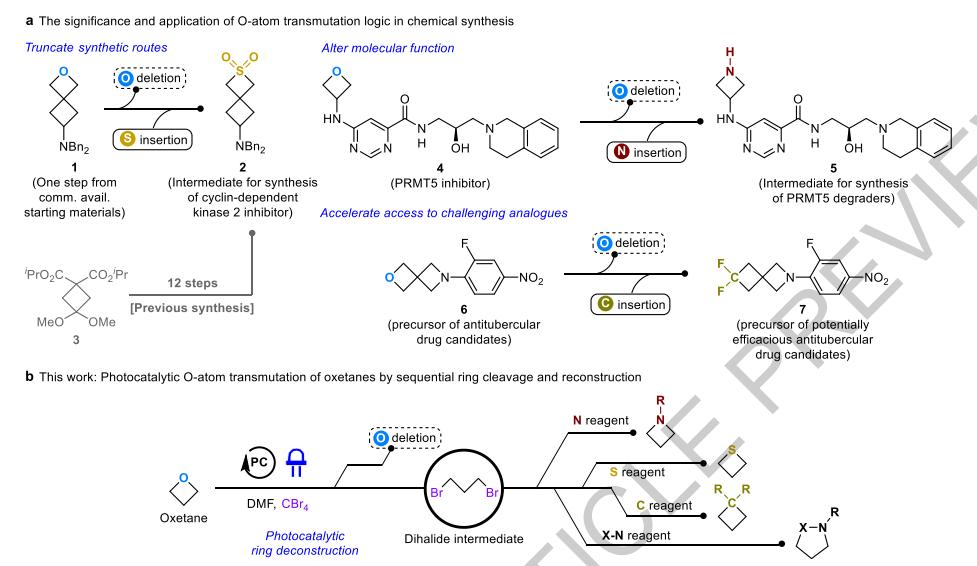
Photocatalytic oxetane editing enables selective O-atom replacement with N, S, or C groups in one step. This versatile method simplifies drug synthesis, supports late-stage functionalization, and exhibits broad functional group tolerance, streamlining access to valuable saturated cyclic scaffolds.
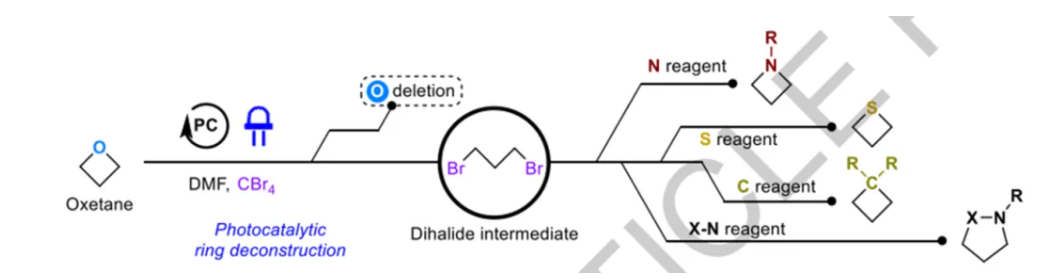
While Lawesson's reagent can achieve the conversion of carbonyl oxygen to carbonyl sulfur, it proves inadequate for replacing the oxygen atom in oxetanes. This study introduces a universal photocatalytic strategy that enables selective substitution of the oxygen atom in oxetanes with nitrogen, sulfur, or carbon-based groups, thereby transforming them into diverse saturated cyclic building blocks through a single operation. The method demonstrates excellent functional group compatibility and is suitable for late-stage functionalization, significantly streamlining the preparation of pharmaceuticals and complex drug analogues that typically require multi-step synthesis. Mechanistic investigations reveal the origin of its high chemoselectivity: the endocyclic oxygen atom is preferentially activated to form an acyclic dihalide intermediate, which subsequently undergoes efficient ring reconstruction under the influence of a nucleophile.
Non-aromatic heterocycles and carbocycles serve as the core scaffolds of numerous bioactive and functional molecules. Among them, four-membered rings such as azetidine, thietane, and cyclobutane—are widely utilized in drug discovery due to their advantageous pharmaceutical properties, including potency, stability, and target specificity.
However, traditional synthetic approaches face several limitations:
l They often rely on disassembling the ring structure into simpler starting materials, which must be prepared separately through multiple steps. This process is energy-intensive, time-consuming, and generates significant by-products.
l They are largely constrained to reactions such as cycloaddition or nucleophilic substitution, which limits the diversity of molecular frameworks that can be constructed.
Research Objective
To address challenges in conventional synthesis by selectively replacing the oxygen atom in the oxetane structural unit with other functional groups (e.g., nitrogen, sulfur, or carbon) via reaction with specific reagents, enabling one-step conversion into high-value four-membered ring drug scaffolds.
Reaction Mechanism
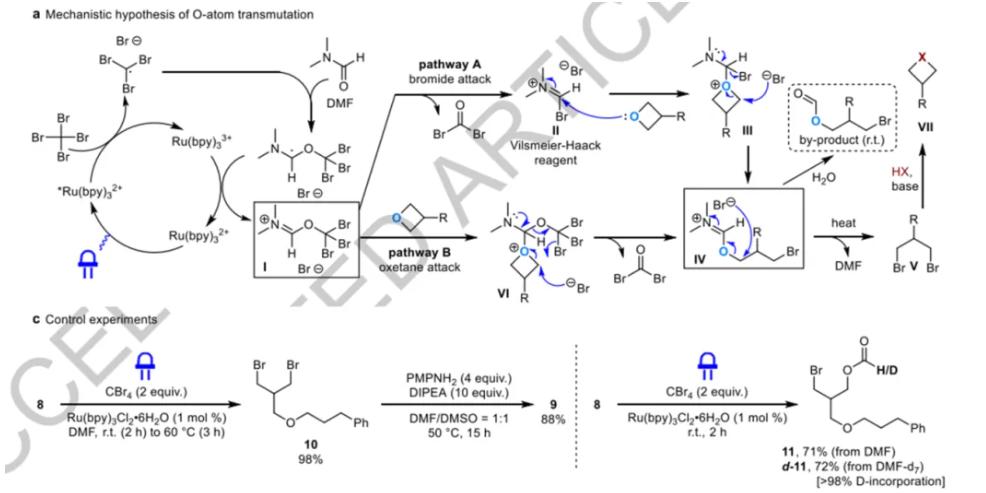
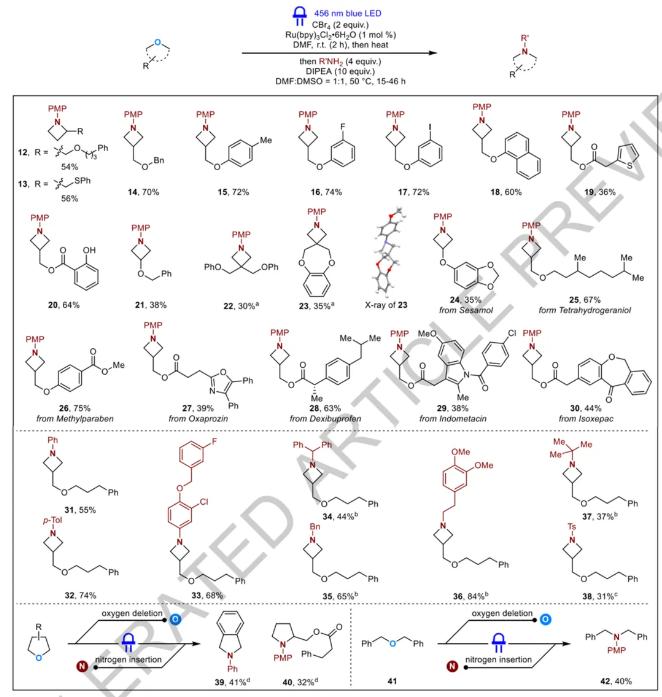
The reaction scope of the photocatalytic oxygen atom transformation system includes O→S, O→N, O→C and O→diatomic transformations. The mechanism reveals that the reaction proceeds through selective ring-opening of the substrate by an acyclic dihalide, followed by efficient ring reconstruction in the presence of a nucleophile. Using the O→N transformation as a model reaction, with substrate 8 (an oxetane containing an acyclic ether), conditions were optimized. The established protocol employs Ru(bpy)₃Cl₂as the photocatalyst and CBr₄(2 equivalents) as the reagent in a DMF solvent system. Under irradiation with 456 nm blue LEDs and with heating, the reaction successfully affords the corresponding azetidine in 85% yield via a one-pot procedure. Notably, the acyclic ether moiety remains intact throughout the process, fully demonstrating the excellent chemoselectivity of this transformation.
Step 1: Photocatalytic Ring-Opening to Generate Dihalogenated Intermediate (V)
The photoexcited Ru catalyst facilitates the reaction between CBr₄ and DMF, generating intermediate I, which preferentially forms the Vilsmeier-Haack reagent II via Path A. Intermediate II then reacts with the oxetane to yield intermediate III. Subsequent nucleophilic attack by Br⁻triggers ring-opening, followed by a substitution reaction to form the dihalogenated intermediate V (with regeneration of DMF).
Step 2: Nucleophilic Ring-Closure Completing Oxygen Atom Replacement
A nucleophile (e.g., an amine, sodium sulfide, or a carbon nucleophile) undergoes a double nucleophilic substitution with intermediate V, leading to ring re-closure and achieving the net O→N/S/C replacement.


Reaction Scope
O→N Transformation
1) Substrates: 2-/3-Substituted oxetanes (bearing functional groups such as arenes, thioethers, haloarenes, esters, thiophenes, phenols, cyclic ethers, etc.; products 12-23).
2) Nucleophiles: *p*-Anisidine, aniline derivatives (31-33), alkyl amines (34-37), sulfonamide (38).
3) Expansion: Five-membered ring substrates → Isoindolines (39), Pyrrolidines (40); Acyclic substrates → Tertiary amines (42).
4) Limitation: Not applicable to oxetanes containing aliphatic alcohols (free hydroxyl groups are prone to bromination).
O→S Transformation
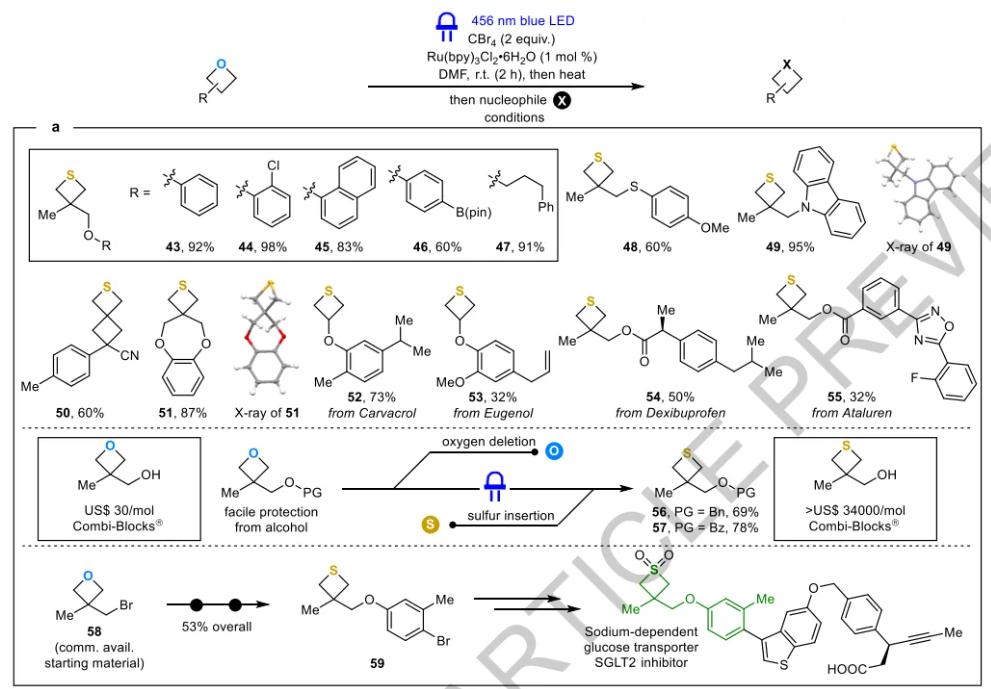
1) Nucleophile: Sodium sulfide.
Products: Thietanes functionalized with phenyl (43), aryl chloride (44), naphthyl (45), boronic ester (46) groups, among others, and drug-related derivatives (52-55).
2) Application: Two-step synthesis of the SGLT2 anti-diabetic inhibitor precursor 59 from commercial oxetane 58 (containing an alkyl bromide).
O→C Transformation
Scope for oxygen atom replacement to generate cyclobutanes, applicable to various carbon nucleophiles.

O→Diatomic Replacement
Using nucleophiles such as hydrazine and hydroxylamine derivatives to achieve four-membered ring → five-membered ring expansion (Pyrazolidine 66, Isoxazolidine 67). All reported yields are isolated yields after purification.

Key Applications
I. Late-Stage Functionalization of Drug Molecules
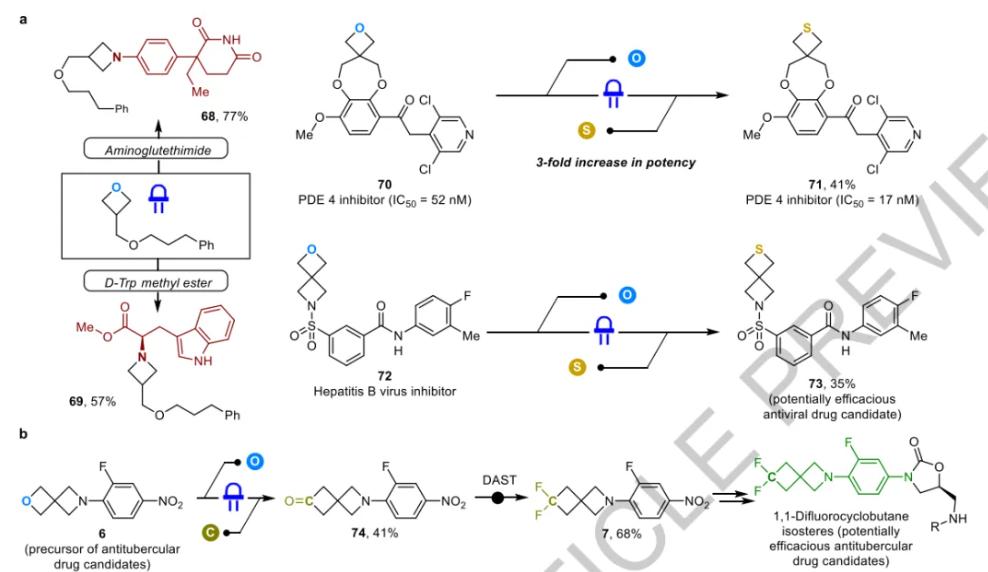
l Oxetane 70 → Thietane 71: A PDE4 inhibitor analogue demonstrating a 3-fold increase in inhibitory activity.
l HBV Inhibitor 72 → Thio-derivative 73: A potential antiviral candidate derived via this transformation.
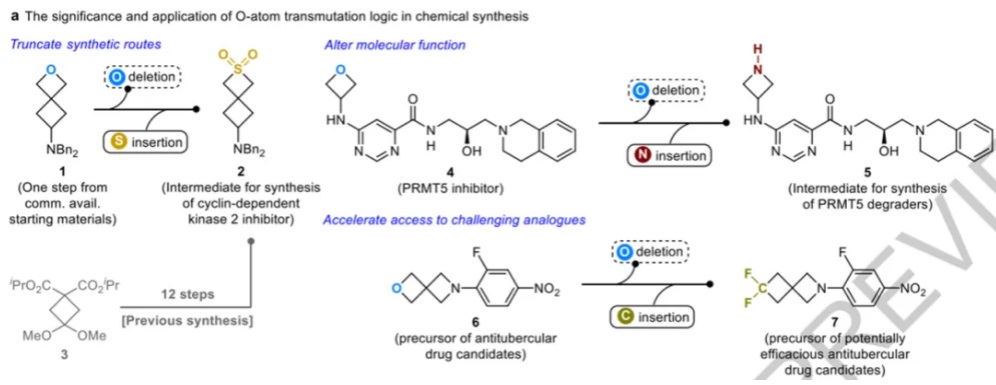
l Anti-tuberculosis Antibiotic Precursor 6 → 1,1-Difluorocyclobutane Analogue 7: Achieved via a combination of O→C transformation and carbonyl deoxyfluorination. This enhances metabolic stability and serves as a powerful late-stage functional group editing tool, effectively circumventing tedious de novo synthesis steps.
II. Streamlining the Synthesis of Drug Intermediates
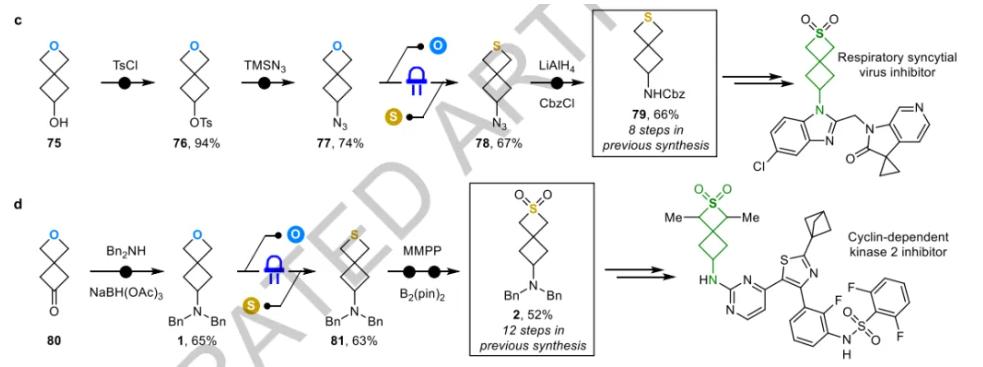
l Anti-RSV (Respiratory Syncytial Virus) Inhibitor Precursor 79:
Traditional Route: 8 steps, requiring expensive starting materials, with an overall yield < 18%.
New Route: 3 steps (tosylation → azidation → O→S transformation), achieving an overall yield of 31%.
l Anticancer CDK2 Inhibitor Precursor 2:
Traditional Route: 12 steps, involving explosive NaN3, precious metal Pd catalysts, and 4 protection/deprotection cycles.
New Route: 2 steps (reductive amination → O→S transformation), achieving an overall yield of 41%.
Summary
l Core Methodology
Utilizes a tandem process of "ring-opening to generate a dihalogenated intermediate, followed by nucleophilic ring-closure" to achieve the selective replacement of the oxygen atom in oxetanes with nitrogen, sulfur, or carbon-based groups.
l Key Advantages
Exhibits high functional group tolerance, compatible with various functional groups such as arenes, thioethers, and esters.
Suitable for the late-stage functionalization of drug molecules, significantly simplifying the synthesis of complex drugs and their analogues.
l Current Limitations
Substrates containing aliphatic alcohols are not suitable, as the free hydroxyl group is prone to bromination.
The substrate scope is primarily limited to four-membered rings; extension to five-membered rings or acyclic substrates results in a limited range of accessible products.
The range of applicable carbon nucleophiles is relatively narrow, currently limited to validated electron-deficient α-functionalized nitriles and malonate esters.
Read More
https://doi.org/10.1038/s41586-025-09723-3