
Sofpironium Bromide
A topical anticholinergic used to treat primary axillary hyperhidrosis.
Overview
Sofpironium bromide (BBI 4000) is an anticholinergic agent used in the study of primary axillary hyperhidrosis (PAH). Sofpironium bromide reduces sweating by inhibiting M3 muscarinic receptors in eccrine glands at the application site. Sofpironium bromide also has a high afnity for the M1, M2, M4 and M5 subtypes.
Synonyms: Pyrrolidinium; (3r)-Sofpironium cation; Sofpironium ion; BBI-4000; ECCLOCK; sofpironii bromidum; bromure de sofpironium; bromuro de sofpironio
Mol File:1607842-55-6.mol
Physicochemical Properties
Storage temp: 4°C, sealed storage, away from moisture
Form: Solid
Color: White to Off-white
MSDS Information
Experimental Data
1. Cell Experiment
Solubility in DMSO: 100 mg/mL (212.59 mM; ultrasonic treatment required. Hygroscopic DMSO significantly affects the solubility of the product. Please use freshly opened DMSO).
Preparing Stock Solutions: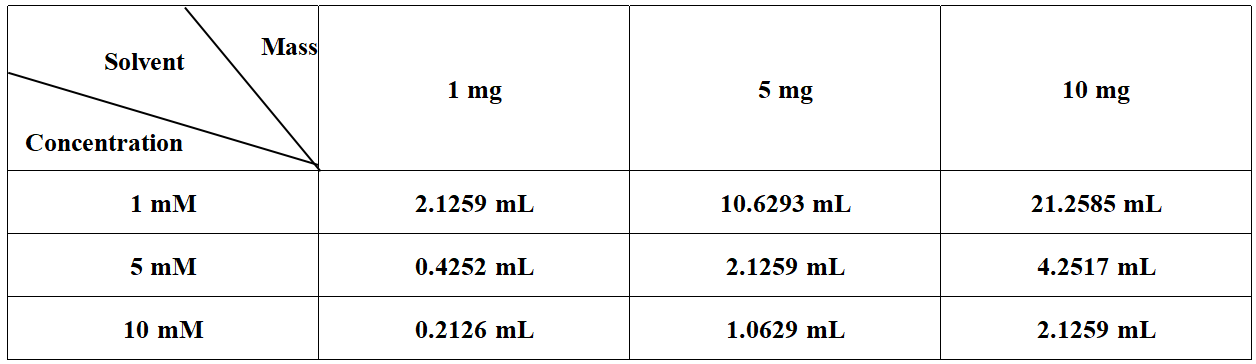
Please select the appropriate solvent for preparing stock solutions based on the product's solubility in different solvents. Once prepared, aliquot the stock solution and store it to avoid product failure caused by repeated freeze-thaw cycles.
Storage conditions and shelf life: -80°C, 6 months; -20°C, 1 month (sealed storage, away from moisture). When stored at -80°C, use within 6 months; when stored at -20°C, use within 1 month.
2. Animal Experiment
Please select an appropriate dissolution protocol based on your experimental animals and route of administration.
The following protocols require first preparing a clear stock solution using the In Vitro method, followed by sequential addition of co-solvents:
— To ensure experimental reliability, the clear stock solution may be stored appropriately according to storage conditions; for in vivo working solutions, it is recommended to prepare them freshly on the day of use.
The percentages indicated before each solvent refer to its volume ratio in the final solution. If precipitation or crystallization occurs during preparation, dissolution can be assisted by heating and/or sonication.
Protocol 1
Please add each solvent in sequence: 10% DMSO, 40% PEG300, 5% Tween-80, 45% Saline.
Solubility: ≥ 2.5 mg/mL (5.31 mM); Clear solution.
This protocol yields a clear solution of ≥ 2.5 mg/mL (saturation unknown).
For example, to prepare 1 mL of working solution: Add 100 μL of a 25.0 mg/mL clear DMSO stock solution to 400 μL of PEG300 and mix well. Then add 50 μL of Tween-80 to the mixture and mix thoroughly. Finally, add 450 μL of saline to adjust the volume to 1 mL.
Preparation of saline: Dissolve 0.9 g of sodium chloride in ddH₂O and bring the volume to 100 mL to obtain a clear and transparent saline solution.
Protocol 2
Please add each solvent in sequence: 10% DMSO, 90% (20% SBE-β-CD in Saline).
Solubility: ≥ 2.5 mg/mL (5.31 mM); Clear solution.
This protocol yields a clear solution of ≥ 2.5 mg/mL (saturation unknown).
For example, to prepare 1 mL of working solution: Add 100 μL of a 25.0 mg/mL clear DMSO stock solution to 900 μL of 20% SBE-β-CD in saline and mix well.
To prepare 20% SBE-β-CD in saline: Dissolve 2 g of SBE-β-CD (sulfobutylether β-cyclodextrin) powder in saline and bring the volume to 10 mL. Mix until fully dissolved to obtain a clear and transparent solution.
Protocol 3
Please add each solvent in sequence: 10% DMSO, 90% Corn Oil.
Solubility: ≥ 2.5 mg/mL (5.31 mM); Clear solution.
This protocol yields a clear solution of ≥ 2.5 mg/mL (saturation unknown). Consider using this protocol for animal experiments lasting longer than half a month.
For example, to prepare 1 mL of working solution: Add 100 μL of a 25.0 mg/mL clear DMSO stock solution to 900 μL of corn oil and mix well.
Pharmacodynamics
Mechanism Of Action
Similar Products
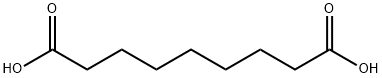
Azelaic Acid
Therapy
: Dermatology
Target
: Antibiotic; Endogenous Metabolite
CAS
: 123-99-9
MF
: C9H16O4
MW
: 188.22
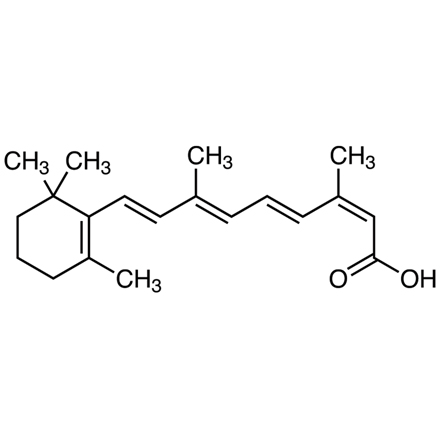
Isotretinoin
Therapy
: Dermatology
Target
: RARs
CAS
: 4759-48-2
MF
: C20H28O2
MW
: 300.44
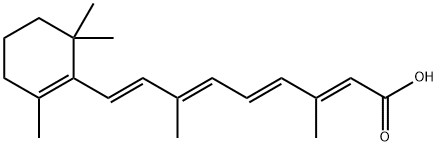
Tretinoin
Therapy
: Dermatology
Target
: RAR-γ;RAR-α;RAR-β
CAS
: 302-79-4
MF
: C20H28O2
MW
: 300.44
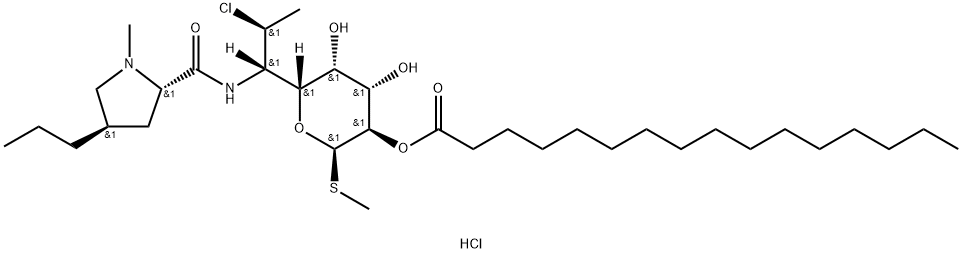
Clindamycin Palmitate HCl
Therapy
: Infectious diseases
Target
: Bacterial proteins
CAS
: 25507-04-4
MF
: C34H64Cl2N2O6S
MW
: 699.85