
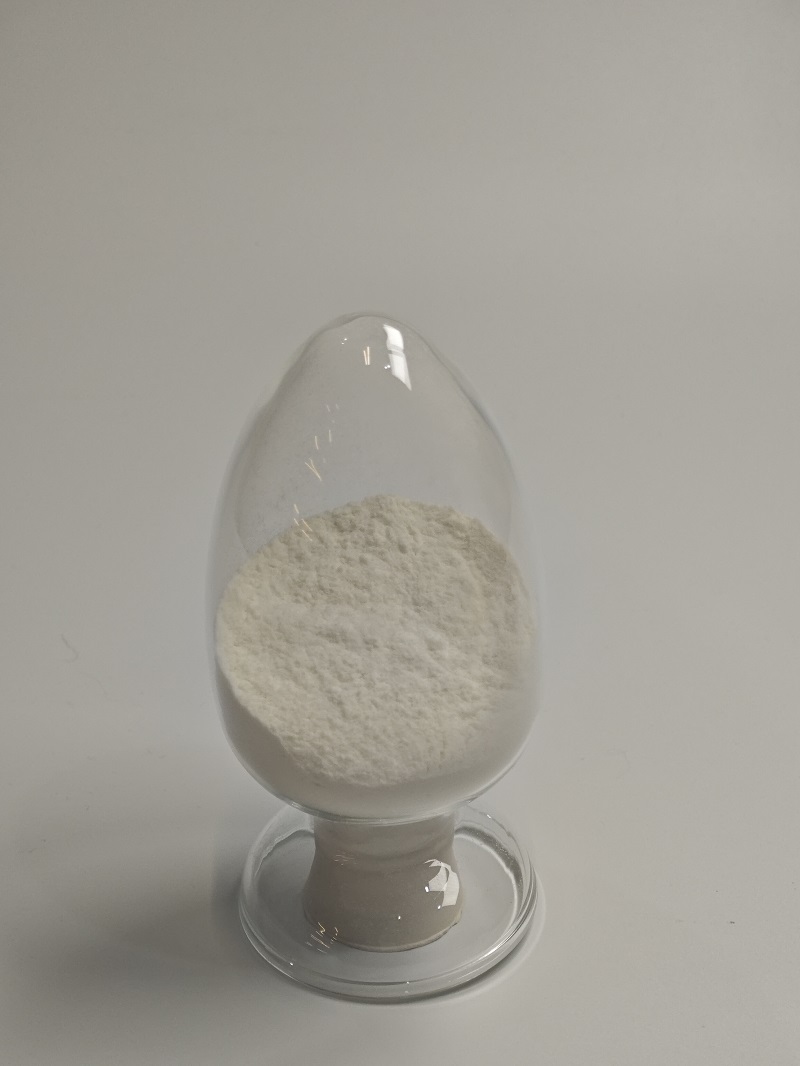
Delgocitinib
A Janus kinase inhibitor used to treat hand eczema in adults.
Overview
Delgocitinib is a potent and specific JAK inhibitor with inhibitory effects on JAK1, JAK2, JAK3, and Tyk2, with IC50 values of 2.8, 2.6, 13, and 58 nM, respectively. Delgocitinib is involved in a variety of inflammatory and autoimmune diseases through JAK-dependent cytokines and is widely used to treat various inflammatory diseases. It is the world's first JAK topical compound for the treatment of atopic dermatitis.
Synonyms: LEO-124249; JTE-052; JTE-052A; LP-0133; Corectim; CORECTIM; Anzupgo; 1,6-DIAZASPIRO(3.4)OCTANE-1-PROPANENITRILE, 3-METHYL-.BETA.-OXO-6-(7H-PYRROLO(2,3-D)PYRIMIDIN-4-YL)-, (3S,4R)-; 3-[(3S,4R)-3-Methyl-6-(7H-pyrrolo[2,3-d]pyrimidin-4-yl)-1,6-diazaspiro[3.4]octan-1-yl]-3-oxopropanenitrile
Product Categories: Agents for Dermatitis, Excluding Corticosteroids; Dermatologicals; Janus Kinase Inhibitor; OAT3/SLC22A8 Substrates; OCT2 Substrates; P-glycoprotein substrates
Mol File: 1263774-59-9.mol
Physicochemical Properties
Storage temp: -20°C
Solubility: DMSO: 58.0 (maximum concentration mg/mL); 186.89 (maximum concentration mM)
Form: Solid
Color: White to Off-white
MSDS Information
Experimental Data
1. Cell Experiment
DMSO : ≥ 58 mg/mL (186.89 mM; Hygroscopic DMSO has a significant impact on the solubility of product, please use newly opened DMSO)
"≥" means soluble, but saturation unknown.
Preparing Stock Solutions:
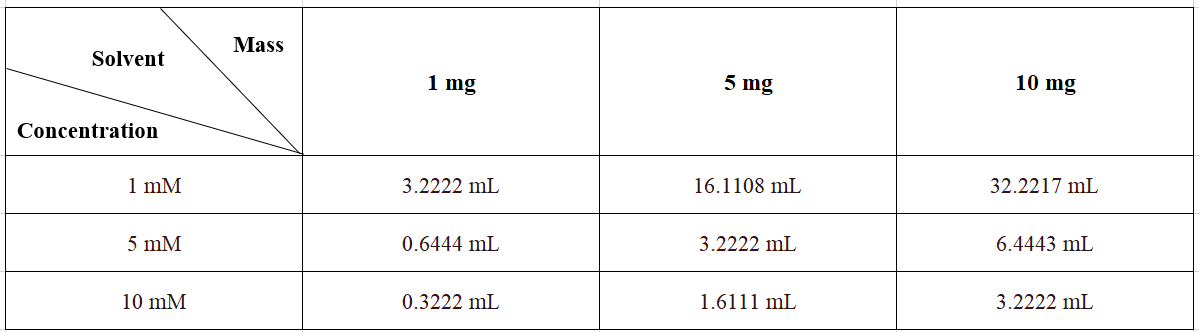
Please refer to the solubility information to select the appropriate solvent. Once prepared, please aliquot and store the solution to prevent product inactivation from repeated freeze-thaw cycles.
Storage method and period of stock solution: -80°C, 2 years; -20°C, 1 year. When stored at -80°C, please use it within 2 years. When stored at -20°C, please use it within 1 year.
2. Animal Experiment
Select the appropriate dissolution method based on your experimental animal and administration route.
For the following dissolution methods, please ensure to first prepare a clear stock solution using an In Vitro approach and then sequentially add co-solvents:
To ensure reliable experimental results, the clarified stock solution can be appropriately stored based on storage conditions. As for the working solution for in vivo experiments, it is recommended to prepare freshly and use it on the same day.
The percentages shown for the solvents indicate their volumetric ratio in the final prepared solution. If precipitation or phase separation occurs during preparation, heat and/or sonication can be used to aid dissolution.
Protocol 1
Add each solvent one by one: 5% DMSO, 40% PEG300, 5% Tween-80, 50% Saline
Solubility: ≥ 2.5 mg/mL (8.06 mM); Clear solution
Protocol 2
Add each solvent one by one: 5% DMSO, 95% (20% SBE-β-CD in Saline)
Solubility: ≥ 2.5 mg/mL (8.06 mM); Clear solution
Protocol 3
Add each solvent one by one: 1% DMSO, 99% Saline
Solubility: ≥ 0.5 mg/mL (1.61 mM); Clear solution
Pharmacodynamics
Delgocitinib works to attenuate inflammation in inflammatory skin conditions by blocking the molecular signalling of inflammatory mediators. In mice models of atopic dermatitis, delgocitinib improved skin barrier function and enhanced enhanced keratinocyte terminal diferentiation. In human clinical trials, delgocitinib improved the clinical signs and symptoms of chronic hand eczema and atopic dermatitis.
Mechanism Of Action
Delgocitinib is a pan Janus kinase (JAK) inhibitor that targets the activity of all four members of the JAK family [JAK1, JAK2, JAK3, and tyrosine kinase 2 (TYK2)] in a concentration-dependent manner. JAK family has been implicated in several inflammatory disorders, as they mediate the signalling of inflammatory cytokines. In human cells, inhibition of the JAK-STAT pathway by delgocitinib attenuates the signalling of several pro-inflammatory cytokines (including interleukin (IL)-2, IL-4, IL-6, IL-13, IL-21, IL-23, Granulocyte-Macrophage-Colony-Stimulating Factor (GM-CSF), and Interferon (IFN)-α) downregulating the immune and inflammatory responses in cells of relevance to CHE pathology. Delgocitinib blocks the activation of inflammatory cells, such as T cells, B cells, monocytes and mast cells, and the production of cytokines.
Similar Products
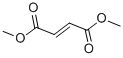
Dimethyl Fumarate
Therapy
: Immune-Inflammatory diseases
Target
: Nrf2
CAS
: 624-49-7
MF
: C6H8O4
MW
: 144.13
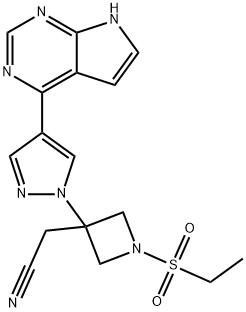
Baricitinib
Therapy
: Immune-Inflammatory diseases
Target
: JAK1;JAK2
CAS
: 1187594-09-7
MF
: C16H17N7O2S
MW
: 371.42
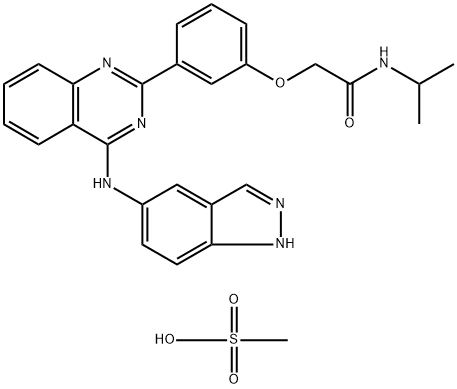
Belumosudil Mesylate
Therapy
: Immune-Inflammatory diseases
Target
: ROCK
CAS
: 2109704-99-4
MF
: C27H28N6O5S
MW
: 548.62
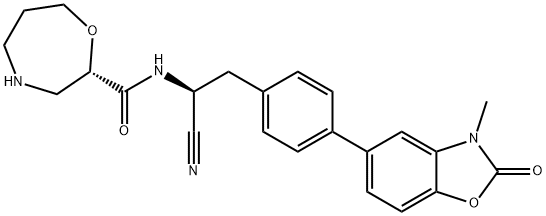
Brensocatib
Therapy
: Immune-Inflammatory diseases
Target
: CTSC
CAS
: 1802148-05-5
MF
: C23H24N4O4
MW
: 420.47